Hi,
at https://www.linkedin.com/pulse/solving-resource-constrained-project-scheduling-problems-laborie/
we can read an excellent post about RCPSP with CP Optimizer.
The python code there is simple but the OPL code that is in CPLEX_Studio129\opl\examples\opl\sched_rcpsp is quite simple too.
using CP;
int NbTasks = ...;
int NbRsrcs = ...;
range RsrcIds = 0..NbRsrcs-1;
int Capacity[r in RsrcIds] = ...;
tuple Task {
key int id;
int pt;
int dmds[RsrcIds];
{int} succs;
}
{Task} Tasks = ...;
dvar interval itvs[t in Tasks] size t.pt;
cumulFunction rsrcUsage[r in RsrcIds] =
sum (t in Tasks: t.dmds[r]>0) pulse(itvs[t], t.dmds[r]);
minimize max(t in Tasks) endOf(itvs[t]);
subject to {
forall (r in RsrcIds)
rsrcUsage[r] <= Capacity[r];
forall (t1 in Tasks, t2id in t1.succs)
endBeforeStart(itvs[t1], itvs[<t2id>]);
}
execute {
for (var t in Tasks) {
writeln("Task " + t.id + " starts at " + itvs[t].start);
}
}
and the .dat that would replace json
{

'ntasks'       : 6,

'nresources'   : 2,

'capacities'   : [ 2,3 ],

'durations'    : [ 2,4,1,1,1,2 ],

'requirements' : [ [ [0,1],[1,1],[2,2],[3,1],[4,1],[5,1] ],
                     [ [0,2],[1,1],[2,1],[3,1],[4,1],[5,2] ] ],

'successors'   : [ [0,2],[0,3],[2,4],[3,4],[3,5] ]
}
would be
NbTasks = 6;
NbRsrcs = 2;
Capacity = [ 2,3 ];
Tasks = {
<0,2,[1,2],{2,3}>,
<1,4,[1,1],{}>,
<2,1,[2,1],{4}>,
<3,1,[1,1],{4,5}>,
<4,1,[1,1],{}>,
<5,2,[1,2],{}>
};
and in the IDE we immediately get
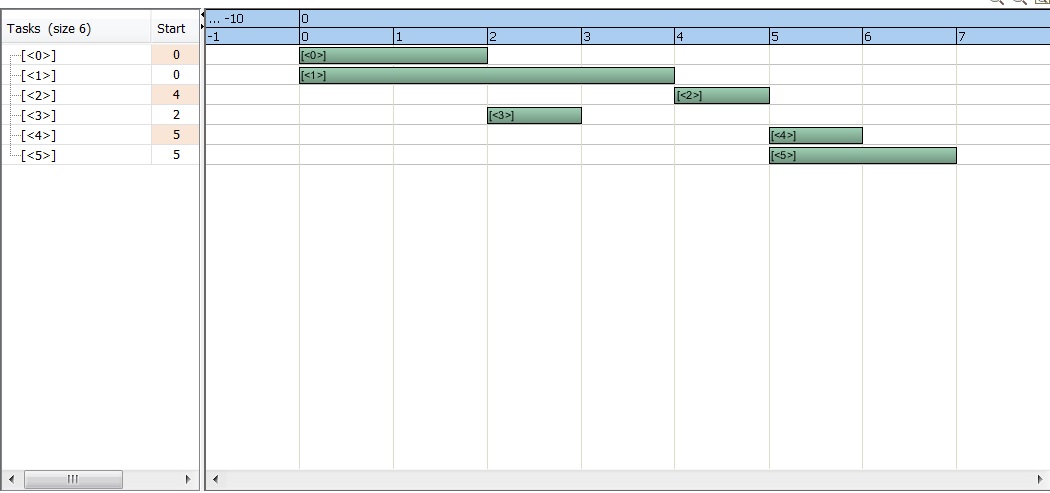
and
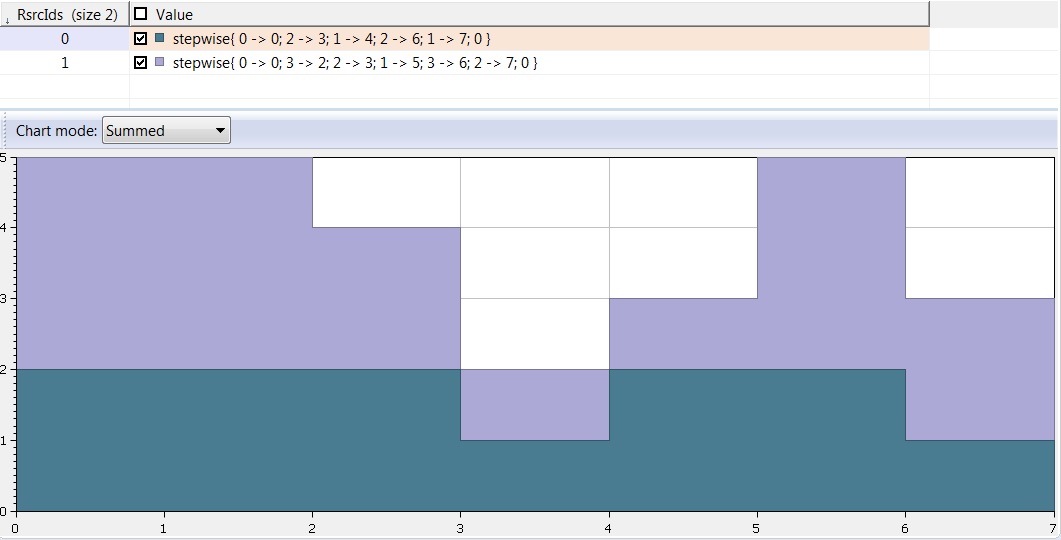
regards
#DecisionOptimization#OPLusingCPOptimizer