Hi,
last year (2018) for PI Day (March 14th) , I posted
where I mentioned some challenges:
- The IBM ponder this challenge
- The mathematical games (33rd year in 2019)
Today is PI day again. March 14th 2019. So let me share a puzzle I enjoyed that was in that later game recently.
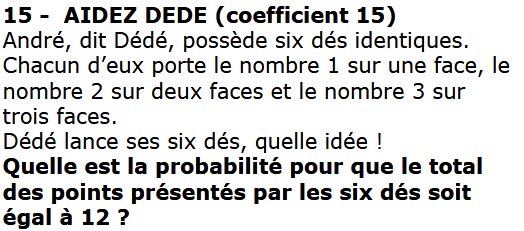
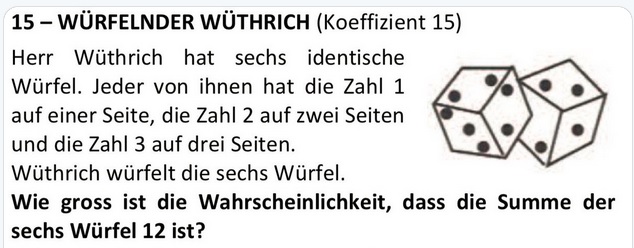
For those who do not speak French or German yet, let me translate into English:
André, said Dede, has six identical dice.Each of them has the number 1 on one side, the number 2 on two sides and the number 3 on three sides.Dede rolls his six dice, what idea! What is the probability for the total points presented by the six dice equals 12?
I used to like this kind of challenges 30 years ago and I still do.
This is a combinatorics problem and the denominator is 6 power 6 for sure.
The numerator is a good example of combinations :
C(3,6)*3^3 + C(2,6)*C(2,4)*3^2*2^2+C(2,6)*2*3*2^4+2^6
Which makes 5284 / 46656
Then since I like OPL I tried to check my result with OPL: double checking never hurts!
A naïve model:
int pos[1..6]=[1,2,2,3,3,3];
int res[a in 1..6][b in 1..6][c in 1..6][d in 1..6][e in 1..6][f in 1..6]=
pos[a]+pos[b]+pos[c]+pos[d]+pos[e]+pos[f];
tuple t
{
int a;
int b;
int c;
int d;
int e;
int f;
}
int nbSol=count(res,12);
execute
{
writeln("probability = ",nbSol," / ",Math.pow(6,6));
}
gives
probability = 5284 / 46656
but this only relies on the modeling part of OPL, not the solving part.
So let's try to rely on CPOptimizer and enumeration now:
using CP;
range possibleValues=1..3;
range dices=1..6;
int occur[i in possibleValues]=i;
dvar int dice[dices] in possibleValues;
subject to
{
sum(i in dices) dice[i]==12;
}
int nbTimes=prod(i in dices) occur[dice[i]];
main
{
cp.param.SearchType=24;
cp.param.workers=1;
var nbSol=0;
thisOplModel.generate();
cp.startNewSearch();
while
(cp.next()) { thisOplModel.postProcess(); nbSol+=thisOplModel.nbTimes; }
writeln("probability = ",nbSol," / ",Math.pow(6,6));
}
which gives the same:
probability = 5284 / 46656
regards and happy PI day
#DecisionOptimization#OPLusingCPLEXOptimizer