Hi,
the June challenge was http://www.research.ibm.com/haifa/ponderthis/solutions/June2019.html
and an additional challenge is to use OPL CPLEX.
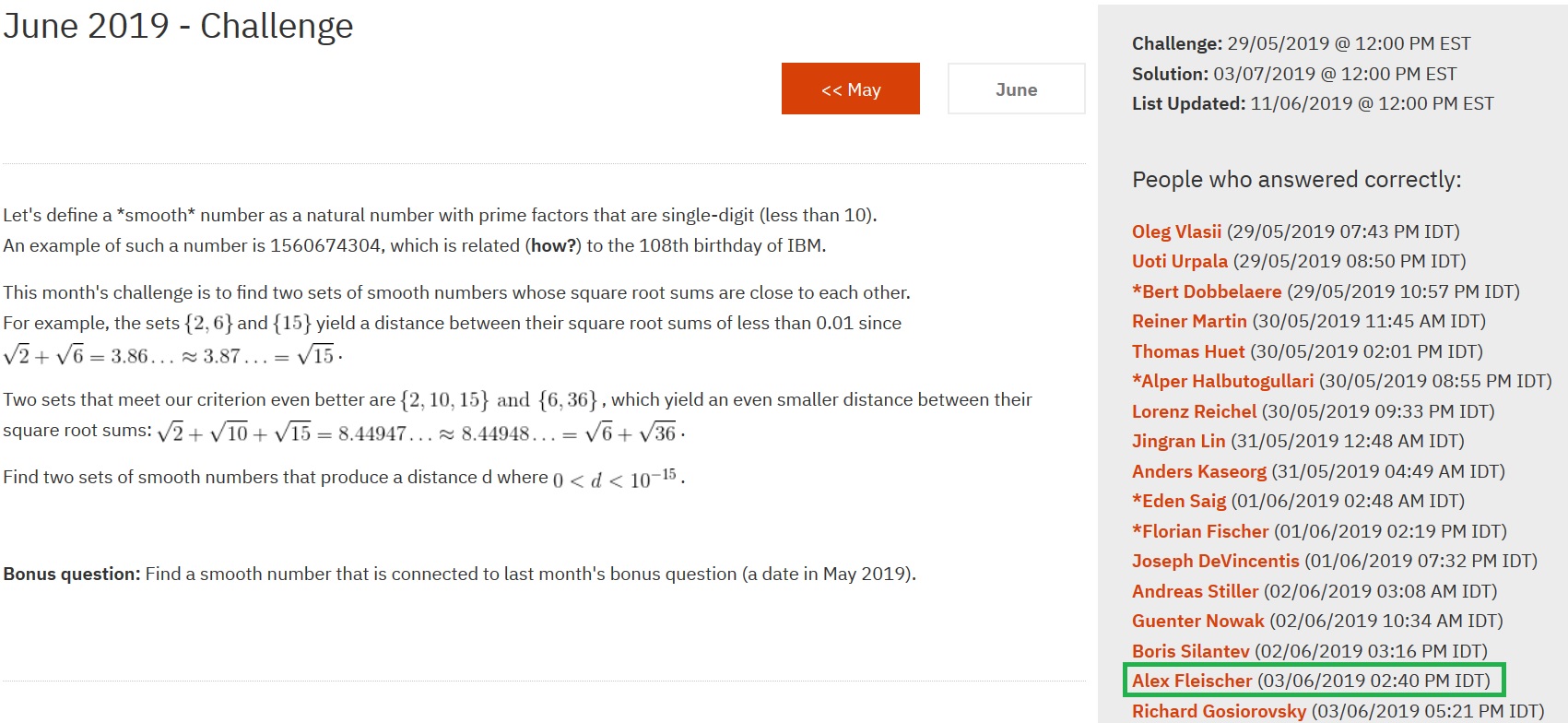
Let me do that in 2 steps:
1) Use MIP to find a solution that is less than 1e-5
2) And then use CPO to turn that into a good solution for 1e-15
1)
{int} p={2,3,5,7};
int n=1;
int n2=2;
int nbRootsMax=4;
int maxy=10;
range r=0..n;
range r2=0..n2;
{int} optionsy={ si*ftoi(pow(i,a))| i in p,a in r2,si in -1..1};
sorted {int} smooths={ ftoi(pow(2,a)*pow(3,b)*pow(5,c)*pow(7,d)) | a,b,c,d in r};
{float} sqr={ sqrt(i) | i in smooths} diff {1.0};
dvar int y[sqr] in -maxy..maxy;
dexpr float delta=sum(i in sqr) y[i]*i;
subject to
{
1<=sum(i in sqr) (y[i]!=0)<=nbRootsMax;
-1e-6<=delta<=1e-6;
forall(i in sqr) (sum(j in optionsy) (y[i]==j))==1;
}
execute
{
for(var i in sqr) if (y[i]!=0) writeln("sqrt(",i*i,") * ",y[i]);
writeln();
}
{int} goodsquares={sgn(y[i])*y[i]*y[i]*ftoi(round(i*i)) | i in sqr : y[i]!=0};
execute
{
writeln(goodsquares);
}
// But let 's use power 3 in order to get the difference less than 10 power -15
int nbCubeGoodSquares=ftoi(pow(card(goodsquares),3));
float cubeGoodSquares[i in goodsquares][j in goodsquares][k in goodsquares]=
i*j*k;
execute
{
var output=new IloOplOutputFile("cubeGoodSquares.dat");
output.write("nbCubeGoodSquares=");
output.write(nbCubeGoodSquares);
output.writeln(";");
output.write("cubeGoodSquares=[");
for(var i in goodsquares) for(var j in goodsquares) for(k in goodsquares)
output.writeln(cubeGoodSquares[i][j][k],",");
output.writeln("];");
output.close();
}
which generates cubegoodsquares.dat and
sqrt(5) * 1
sqrt(7) * -9
sqrt(21) * -2
sqrt(105) * 3
{5 -567 -84 945}
2) Use CPO:
using CP;
execute
{
cp.param.timelimit=120;
}
{int} p={2,3,5,7};
int n=1;
int maxy=10;
range r=0..n;
sorted {int} smooths={ ftoi(pow(2,a)*pow(3,b)*pow(5,c)*pow(7,d)) | a,b,c,d in r};
{int} sqr=smooths; // diff {1};
int nbCubeGoodSquares=...;
range goodsquares=1..nbCubeGoodSquares;
int cubeGoodSquares[goodsquares]=...;
dvar int y[goodsquares] in 1..1000000;
dvar int squaresmooth[goodsquares];
dvar int s[goodsquares] in -1..1;
dvar int multiplier[smooths];
range r4=1..4;
dvar int power[smooths][r4][p] in 0..8;
dvar boolean needed[smooths][r4]; // do we need that term ?
dvar int term[smooths][r4];
minimize sum(i in smooths,j in r4) needed[i][j];
subject to
{
forall(i in goodsquares)
{
squaresmooth[i] in sqr;
cubeGoodSquares[i]==y[i]*y[i]*s[i]*squaresmooth[i];
}
forall(i in smooths) multiplier[i]==sum(j in goodsquares) (squaresmooth[j]==i)*y[j]*s[j];
// and now decompose the multipliers as sum of smooth numbers
forall(i in smooths)
{
ftoi(abs(multiplier[i]))==sum(j in r4) needed[i][j]*term[i][j];
forall(j in r4)term[i][j]==prod(k in p)ftoi(pow(k,power[i][j][k]));
}
}
execute
{
writeln("the cube");
for(var i in smooths) if (multiplier[i]!=0) writeln(multiplier[i]," * sqr of ",i);
}
{int} list1={ term[i][j]*term[i][j]*i | i in smooths,j in r4 : (multiplier[i]>=1) && (1==needed[i][j])};
{int} list2={ term[i][j]*term[i][j]*i | i in smooths,j in r4 : (multiplier[i]<=-1) && (1==needed[i][j])};
execute
{
writeln();
writeln("So the two lists are ");
writeln(list1);
writeln(list2);
}
with that .dat and then we get the solution:
So the two lists are
{2657205 51200000 3732480 8573040 1620304560 6827950080 47840625}
{14288400 96446700 326592 7533176175 1701 1801088541}
3) We can even double check with python high precision that we're right:
from decimal import *
getcontext().prec = 40
l1=[2657205, 51200000, 3732480, 8573040, 1620304560, 6827950080, 47840625]
l2=[14288400 ,96446700, 326592 ,7533176175 ,1701, 1801088541]
s1=sum([Decimal.sqrt(Decimal(i)) for i in l1])
s2=sum([Decimal.sqrt(Decimal(i)) for i in l2])
print(s1)
print(s2)
print(Decimal(s2-s1));
which gives
143446.5588138200170046814527613232168467
143446.5588138200170043256720431189535309
-3.557807182042633158E-16
So the solution is fine.
Again MIP and CPO within OPL CPLEX were great
regards
https://www.linkedin.com/pulse/puzzles-having-fun-useful-mathematics-alex-fleischer/
#DecisionOptimization#OPLusingCPLEXOptimizer