Hi,
a few months ago I tried to help

in the puzzle
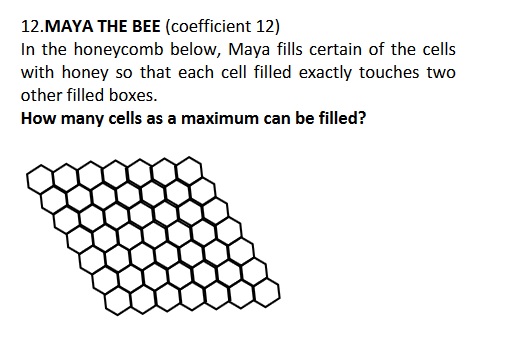
The contest was Mathematical Games championship http://homepage.hispeed.ch/FSJM/documents/31_DF_Enonces_CH_E.pdf
A solution is
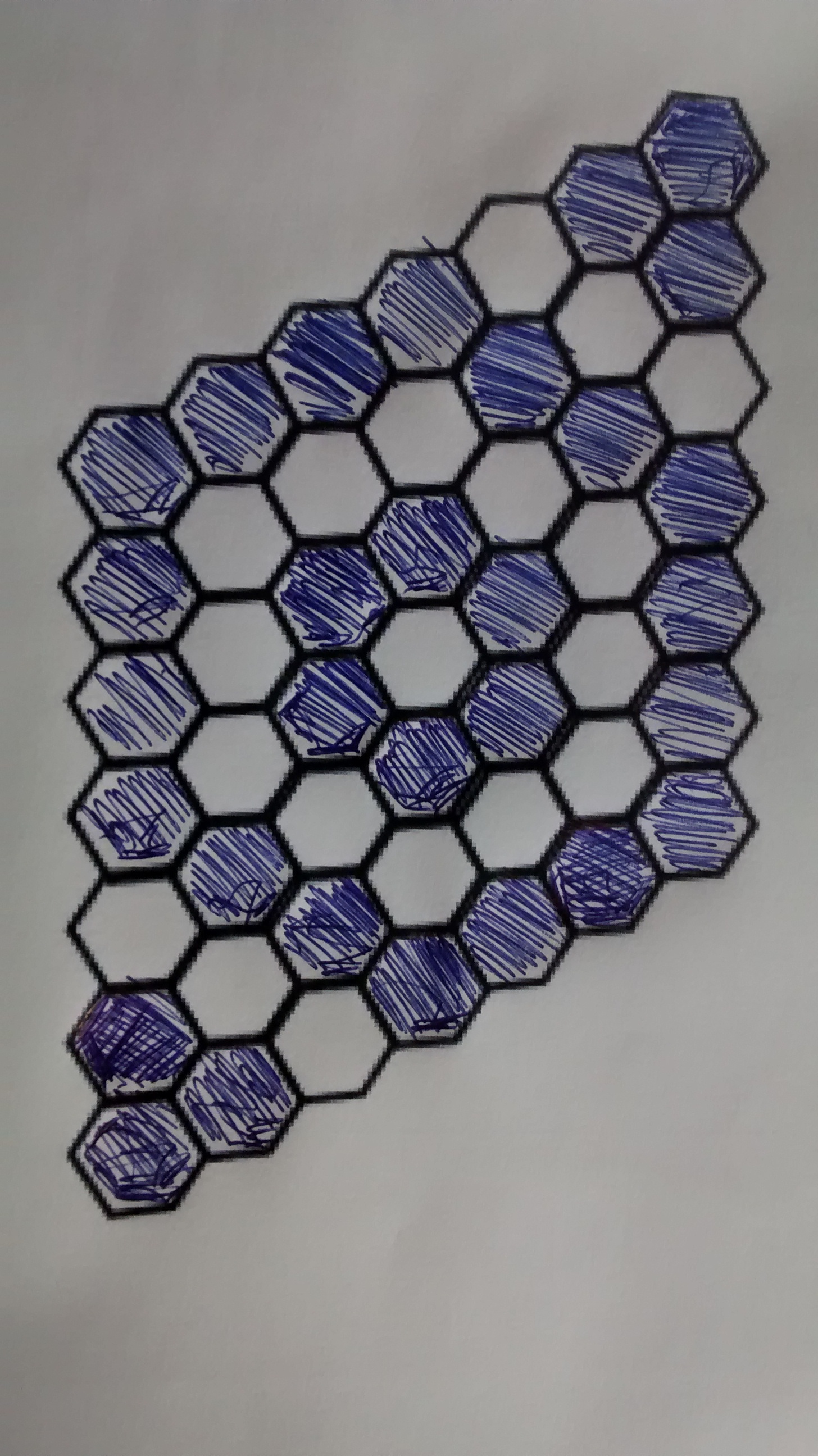
but is that the best solution ?
I knew CPLEX could prove that and a friend reminded me 2 days ago that I had said so at http://www.cijm.org/images/documents/370/visuel2017.jpg
So I wrote a small OPL model to prove the solution and help Maya:
int n=7;
tuple link // a link between 2 cells
{
int i1;
int j1;
int i2;
int j2;
}
// all links between adjacent cells
{link} links=
{<i1,j1,i2,j2> | i1,j1,i2,j2 in 1..n :
((i1!=i2) || (j1!=j2)) && (abs(i2-i1)<=1) && (abs(j2-j1)<=1)
&& ((j2-j1)!=(i2-i1)) };
int nbLinks[i in 1..n, j in 1..n]=card({<i,j,i2,j2> |<i,j,i2,j2> in links} );
assert nbLinks[1,1]==2;
assert nbLinks[n,n]==2;
assert nbLinks[1,n]==3;
assert nbLinks[n,1]==3;
assert forall(i,j in 2..n-1) nbLinks[i,j]==6; // hex game!
assert forall(i in 2..n-1) nbLinks[1,i]==4;
assert forall(i in 2..n-1) nbLinks[i,1]==4;
assert forall(i in 2..n-1) nbLinks[n,i]==4;
assert forall(i in 2..n-1) nbLinks[i,n]==4;
// is a given cell colored ? Yes or no ?
dvar boolean x[1..n][1..n];
// the objective
dvar int nbColoredCells;
maximize nbColoredCells;
subject to
{
//objective is the sum of colored cells
nbColoredCells==sum(i,j in 1..n) x[i][j];
// for all cells if the cell is colored then exactly 2 adjacent cells are colored
forall(i,j in 1..n)
(x[i][j]==1)=>(2==sum(i2,j2 in 1..n:<i,j,i2,j2> in links)x[i2][j2]);
}
which gives
nbColoredCells = 30;
x = [[1 1 0 1 1 1 1]
[1 0 1 0 0 0 1]
[0 1 0 1 1 0 1]
[1 0 1 0 1 0 1]
[1 0 1 1 0 1 0]
[1 0 0 0 1 0 1]
[1 1 1 1 0 1 1]];
So, in a nutshell, CPLEX can prove some theorems since CPLEX proves optimality
regards
#DecisionOptimization#OPLusingCPLEXOptimizer