Businesses nowadays are dealing with more complicated problems than ever before. Organizations are under greater pressure than ever to get more done with less resources because of hybrid work, increased operational costs, broken systems, and a lack of competent workers. The enterprise resource planning (ERP) ecosystem is at the heart of this problem. It includes core systems like SAP, Oracle, Workday, and Microsoft Dynamics that work together to manage finance, procurement, HR, the supply chain, and operations.
Even while ERP platforms have come a long way, many of their cross-functional workflows still rely on manual activities, repetitive data handling, and procedures that are kept apart from each other. These gaps make it harder for corporations to make decisions and respond rapidly to change.
Agentic AI, or autonomous, goal-driven digital agents, is the next big step in smart automation. And IBM Watson Orchestrate is leading the way in this change by helping businesses turn their ERP workflows into smart, self-optimizing business processes.
What is AI that is agentic?
Agentic AI is more than just chatbots, rules, and regular automation. Agentic systems can do the following instead of relying on scripted workflows:
- Understand business goals that are written in plain language
- Use AI-driven reasoning to break goals down into tasks.
- Make sure that apps and data sources work together.
- Act on your own, with rules and openness
- Work with employees as smart digital partners.
This change makes it easier for companies to streamline ERP-heavy tasks and give employees more time to work on more important things.
Introducing Watson Orchestrate: AI Agents for the Enterprise
IBM's Watson Orchestrate is an agentic AI platform that lets digital workers do activities in ERP, CRM, HR, supply chain, and industry-specific apps. It leverages big language models, APIs, automations, and enterprise-level governance to create digital workflows that are self-driving, easy to understand, and follow the rules.
With Watson Orchestrate, employees may easily say what they want to do:
You say, "Get a summary of vendor performance for Q3 from SAP and send it to procurement." The agent:
- Logs into SAP
- Gets records from vendors
- Uses logic to sort Q3 data
- Uses AI to make insights shorter
- Uploads results and lets stakeholders know
No writing. No building of workflows. No need to switch between systems by hand.
The system figures out what needs to be done, carries out tasks across linked apps, and produces an output that may be acted on right away.
Why ERPs Need Agentic AI Right Now
Even the best ERP systems have trouble working:
- A lot of work is done by hand: data input, approvals, reconciliation, and updates all need people to do them.
- Limited interoperability: Finance, HR, procurement, and the supply chain generally work in their own modules.
- Slow cycle times: Processes with more than one stage need teams to work together and send emails.
- A lot of work goes into configuring ERP workflows, which costs a lot of time and money.
Watson Orchestrate adds smart automation on top of the ERP without modifying it, speeding up the change while keeping the system's integrity.
How Watson Orchestrate Improves ERP Workflows
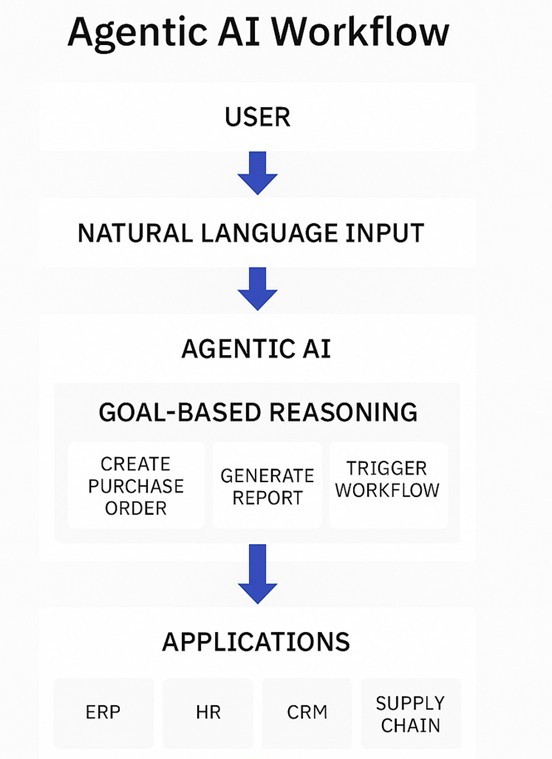
There are four main parts that make up Watson Orchestrate:
1. Ability/Skills
Skills are reusable, API-connected abilities like "Create purchase requisition," "Pull vendor master data," or "Trigger case in ServiceNow." You may put these skills together in different ways to make complicated workflows.
2. Reasoning Based on Goals
The system uses natural language to figure out what the user wants. It then makes a strategy using AI, breaking the request down into actions that can be done in both ERP and business systems.
For example, the goal is to "Update vendor contract and alert legal team."
Plan for AI:
- Get information about vendor contracts from ERP
- Make updates
- Save the new version
- Email is legal for approval.
3. Being aware of the situation
Watson Orchestrate keeps track of context, such as user preferences, past actions, workflow history, and ERP business rules, to make sure that outputs are always the same and useful.
4. Independent Execution
Tasks are done in SAP, Workday, Oracle, Salesforce, Jira, and custom apps, and there are built-in audit trails and governance. Watson Orchestrate combines automation, LLM reasoning, and enterprise governance, all in real time.
Use Cases: Changing ERP Workflows using Agentic AI
1) Automation of Procurement
Watson Orchestrate can make important procurement tasks like onboarding vendors, making purchase requests, and keeping an eye on contract status easier. The system can start activities, find exceptions, and warn teams ahead of time by linking ERP data with AI thinking.
2) Finance and Accounting
The agent can automate tasks that need to be done again and over again, such as matching invoices, reconciling finances, reporting at the end of the month, and analyzing budget variances. This helps financial teams get rid of process bottlenecks and make sure they follow the rules.
3) HR and Talent Operations
Watson Orchestrate can help with onboarding, assigning roles, training, and performance-related updates. This cuts down on administrative work and makes the employee experience better.
4) Operations in the Supply Chain
Agents may keep an eye on inventory, set off triggers for restocking, combine reports from suppliers, and make status summaries to assist businesses react more quickly to changes in supply.
A New Way to Increase Business Productivity
Agentic AI brings a whole new way of doing things to enterprise workflows:
Traditional Automation | AgenticAI with Watson Orchestrate
| Rule-based |
Goal-driven |
| Fragile to changes |
Adaptable and context-aware |
| Linear workflows |
Dynamic orchestration |
| Manual task initiation |
Autonomous execution |
| Requires scripting |
Operates through natural language |
What Will Intelligent ERP Workflows Be Like in the Future?
As more businesses use hybrid cloud, modern integration platforms, and AI to help them make decisions, agentic AI will become the glue that holds ERP systems together and makes them more responsive, predictive, and focused on people.
Watson Orchestrate is a major part of this change because it offers:
- Faster time to value with modular skills
- Governance and security in business
- Low-code extensibility
- Support for hybrid cloud and multi-app ecosystems built in
Businesses can get closer to having self-driving business operations that learn, adapt, and change with the demands of the organization by adding smart digital agents to teams.
In conclusion
Agentic AI is changing the way businesses work. Companies can boost productivity, make their operations more resilient, and leverage automation that goes well beyond typical workflows with Watson Orchestrate. As ERP systems become more complicated, Watson Orchestrate gives businesses a future-ready base for smart automation that helps teams operate smarter, quicker, and with more information.
Written by: Shilpi Yadav and Dipali Darji