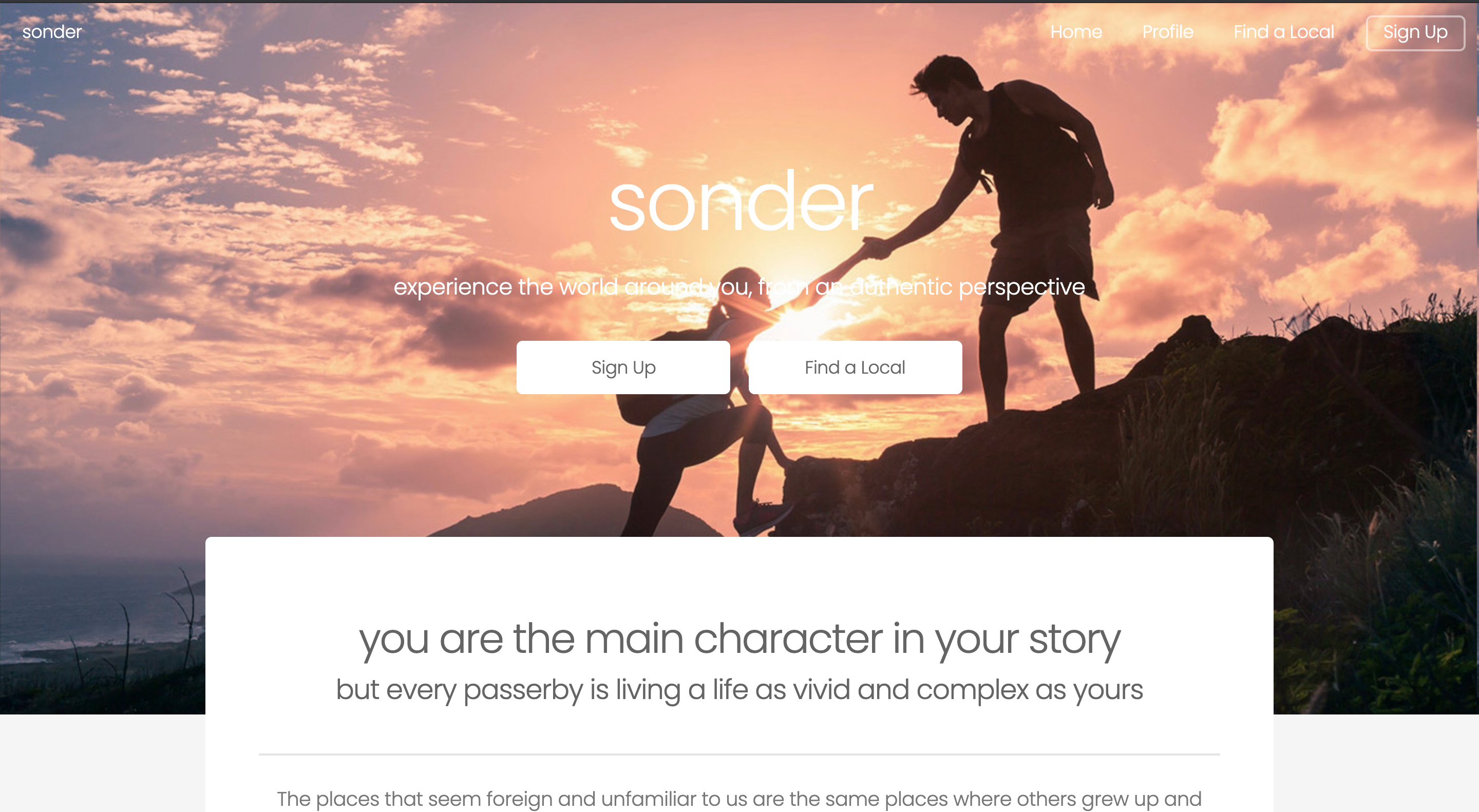
Description: A social good project made by students who attended SacHacks 2021, a collegiate hackathon sponsored by IBM.
Overview
The team, consisting of Kavihesha Kanagalingam, Urmi Lalchandani, and Ipsa Parekh from UC Davis, spent thirty-six hours at SacHacks 2021 creating a machine learning platform, Sonder, to assist tourists and travellers. We are Computer Science and Engineering students and we decided on creating a platform that would be accessible to travellers due to our past travel experiences, where we all would have benefitted from help from the locals.
Inspiration and Purpose
Sonder is the realization that every random passerby is living a life as vivid and complex as our own (coined by John Koenig). We felt that this term perfectly encapsulates our app, which aims to connect individuals who would not otherwise meet.
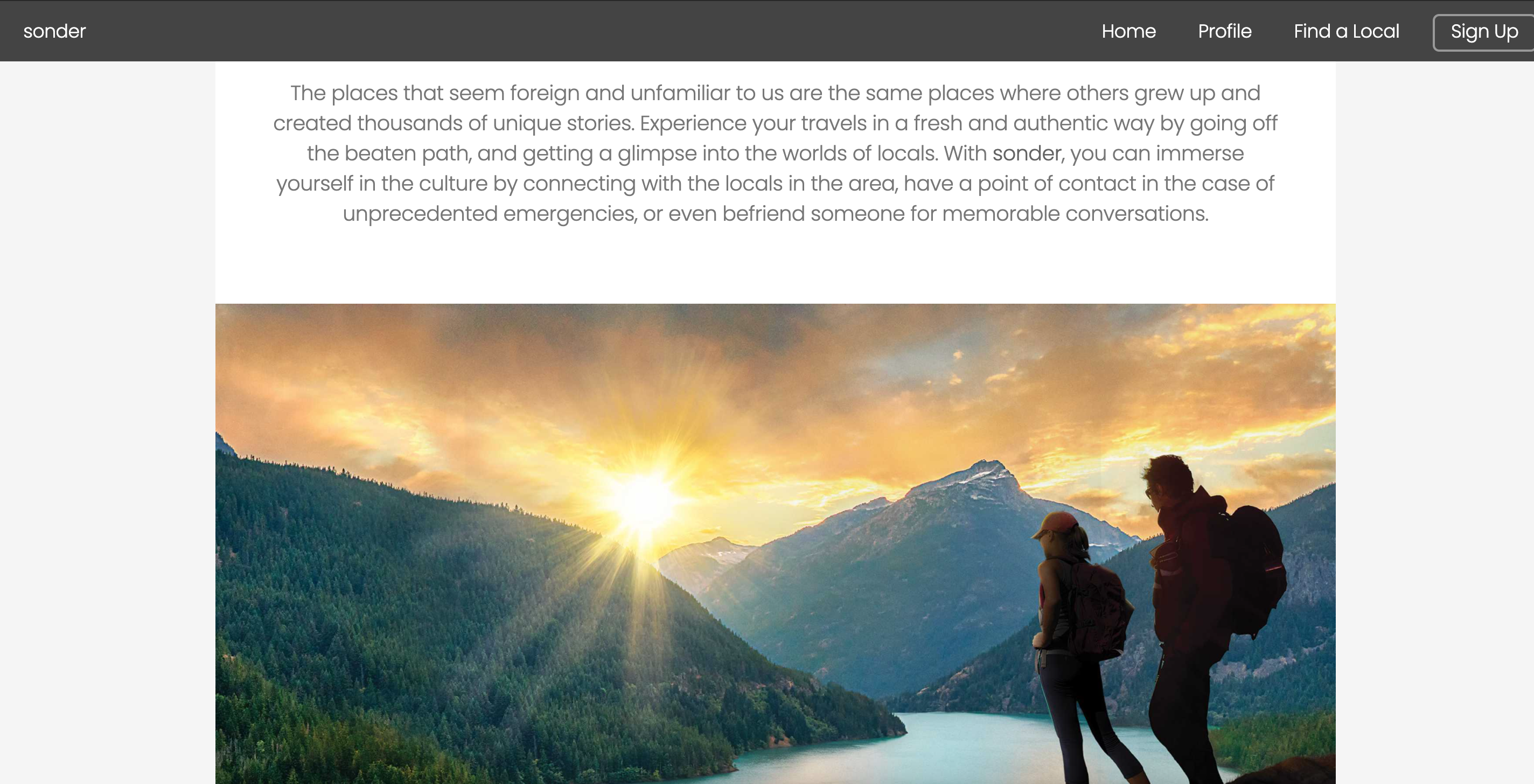
Sonder represents the idea that the places that seem foreign and unfamiliar to us as tourists are the same places where others grew up and created thousands of unique stories. These locals have memories attached to the nooks and crannies of their towns, and can give you a glimpse into what life is like over there. Experience your travels in a fresh and authentic way by going off the beaten path and being a part of the worlds of locals.
There may be occasions when you are unable to get help in an unknown place. In the case of emergencies where you do not know how to contact the authorities and may not be near people, it helps to be able to contact someone who knows the area. They may be able to help you themselves, or at the very least show you how to get professional help.
At the same time, it is important to stay safe during your travels. Sonder will conduct a thorough background check of any users. The locals who sign up to help tourists will receive compensation, and the tourists who register to use Sonder’s services will pay a small fee.
With Sonder, you can immerse yourself in the culture by connecting with the locals in the area, have a point of contact in the case of unprecedented emergencies, or even befriend someone new and have memorable conversations.
To help the users connect with locals in the area for recreational activities, we built a machine learning model based on a natural language processing filter to recommend locals who have similar interests as you. The datasets of locals with their expertise and interest were processed through the machine learning model executing on the IBM-Z mainframe.
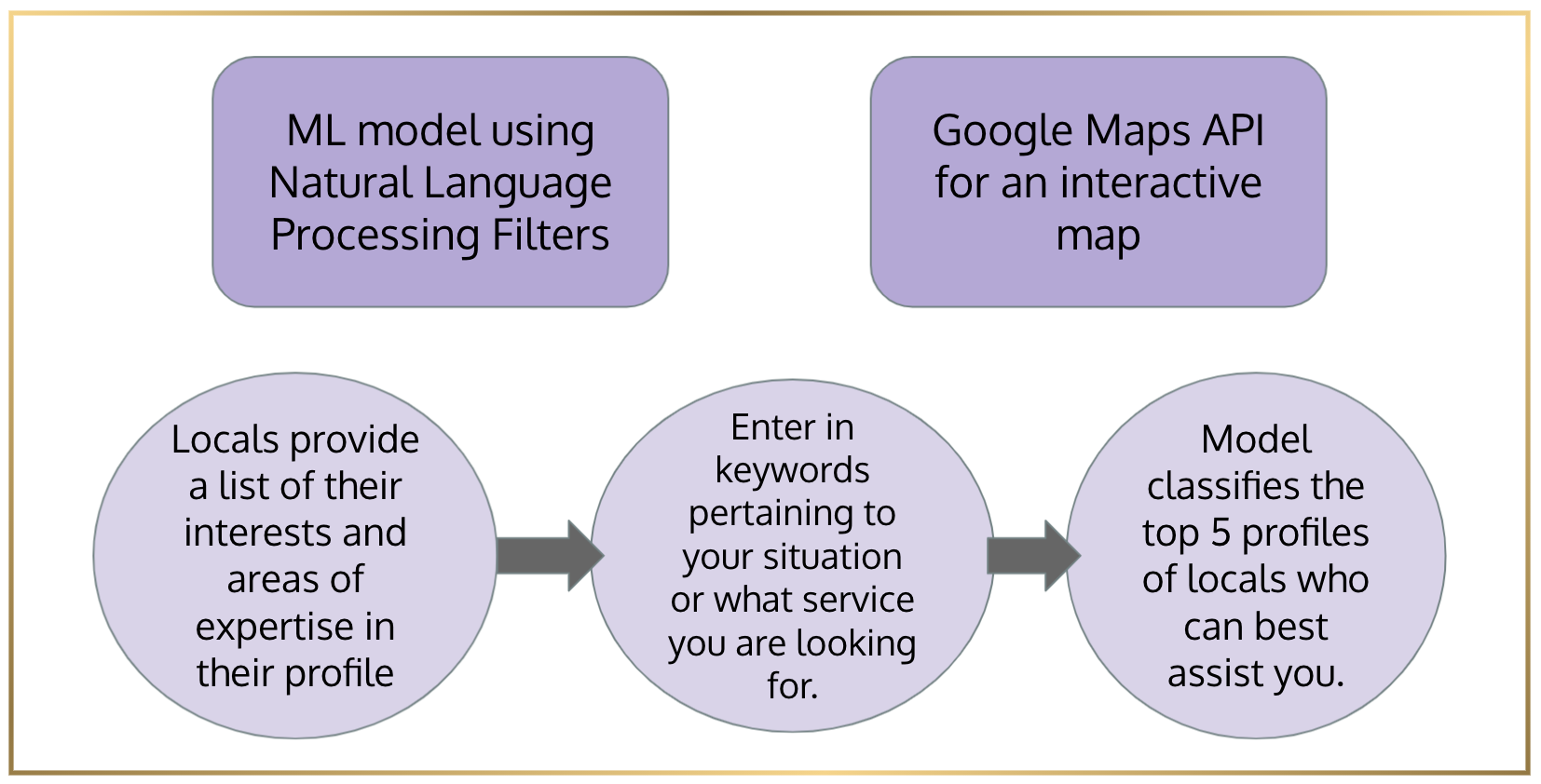
Our natural language processing model then parses through the keywords to classify the top 5 profiles of the locals that will be able to assist you given your situation. It vectorizes the user inputs (keywords describing the type of services they are requesting) and each of the locals’ provided keywords describing the services they can provide, and measures the similarity across word vectors. It then calculates a similarity score between the user and each local, and sorts the locals based on their score to determine the best match for the user’s needs. The locals whose keywords matched more of the user’s provided keywords have a higher score.
In order to make this more effective in terms of distance, we have utilized the Google Maps API to create an interactive map where you can see locals pinned to find the closest local to you.
Next Steps
We would like to incorporate more profiles and information about the user base. As of right now, we have a sign up page that allows the users, both locals and travellers, to enter their information. For registered locals, we would like to incorporate a background check that will ensure that the locals are trustworthy and do not have any criminal records.
As a deep learning platform, we will be able to train our model more accurately given more datasets on keywords as more locals and travellers use this application. The more keywords that are added into the model, the better our model will perform when recommending locals to tourists.
Additionally, we can include more filters, including language, age and distance, to constrain the number of locals in the area before passing it through the machine learning model. This will improve the speed and accuracy at which the model performs.
We are extremely grateful to SacHacks and IBM for giving us the opportunity to develop this idea. Learning how to use IBM Z and actually utilizing it to develop a creative approach to improve a common experience was a great experience for us, and we look forward to using the platform for future computational endeavors.