How do I understand how dollars flow in a model?
There are two concepts you'll want to ingrain when you begin modeling that will make modeling and reporting easier to grasp. The two concepts are Keys (DB Reference Keys) and Granularity (Unique Identifiers), and there's nothing tricky about them. Let's review a Database Reference Key allocation line and see how these concepts apply:
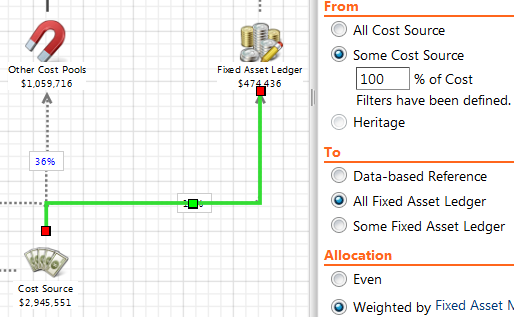
Dollars from the Cost Source are flowing up to rows in the Fixed Asset Ledger. Now let's look at Keys and Granularity. Here is a selection of entries in the Cost Source:
| Unique Identifier | Journal Description | CS to FA Key | Amount |
|---|
| 423 - EY1558000 | Team 423's Prolexicon Alphemitters | CS to FA Key - 423 | 1,000 |
| 423 - EY1612000 | Ranglex Server Node Sentimilectres | CS to FA Key - 423 | 1,000 |
| 523 - EY1614000 | Foam | CS to FA Key - 523 | 5,000 |
Our granularity in this selection is three (3), because it has three individual rows. The Cost Source's granularity in this example comes from the Unique Identifier field, a combination of its Account (e.g. 423) and Cost Center (e.g. EY1558000). The granularity of an object is the most detailed level at which you may report on that object. So for this model, you can report on line items at the Account and Cost Center level, but if there are Sub-Cost Centers associated with each Cost Center, you would see {Various} results if you try to look at them on a Cost Source object report.
How those costs flow, however, are by Key. The key is less granular, because it groups rows by Account only. This means the following groups of costs are sent to the Fixed Assets object:
| CS to FA Key | Amount |
|---|
| CS to FA Key - 423 | 2,000 |
| CS to FA Key - 523 | 5,000 |
And that is the "key" to understanding how dollars flow! Enjoy!