Agentic Memory series (Part 1 of 3) • 6 min read • By Suyash Dubey
About this series
Three posts follow one customer-care case to show what agentic memory changes in IBM watsonx Orchestrate.
- Remember the customer (this post): how memory carries a case across conversations, shown on real product screens.
- Learn as an organization (coming next): how a verified lesson from one case could help every care agent, without sharing personal details.
- Govern what is remembered (coming next): what stops remembered context, or a manipulated document, from justifying the wrong action.
What you will gain: a clear map of the capabilities behind agent memory, what IBM watsonx Orchestrate does today, and the questions to answer before memory shapes decisions across your organization.
Customers shouldn't have to repeat themselves to an AI agent. When a customer comes back, the next conversation should pick up where the last one ended. For the customer, that means less repetition. For a care team, it means fewer lessons lost between cases.
This first post shows how agentic memory does this, using real IBM watsonx Orchestrate screens. It also sets up the question the series explores next: how one customer's experience could help an entire organization.
IBM watsonx Orchestrate memory is a preview capability. It needs to be enabled for both the agent and the user. See the FAQ at the end of this post for details.
What is agentic memory?
Enterprise AI agents can reason, call tools and coordinate work. They also keep short-term context during a conversation. Yet a customer returning tomorrow shouldn't have to rebuild everything the agent understood today.
Agentic memory carries useful experience beyond the current conversation. It lets an application keep selected facts, preferences and outcomes, then retrieve them when a later interaction needs them. The difference is continuity across conversations, not whether an agent can follow the conversation it's having now.
This has been part of IBM watsonx Orchestrate for months. By April 2026, IBM was already highlighting cross-session memory and the ability to inspect, edit and clear what agents remember. See IBM's April product update.
Industry terms describe different parts of this experience: episodic and semantic memory, dynamic orchestration, multimodal perception and autonomous learning. We explain each one in plain language below. The terms come from an illustrative capability image credited to Gartner (reference 853589). In IBM watsonx Orchestrate, memory works with agents, tools and visual evidence to do three things: recall what matters, decide what comes next and apply a verified lesson later.
One customer, two ways to resume
Consider Maya, returning to customer care about faulty headphones. We recorded her return in IBM watsonx Orchestrate twice: once with memory switched off and once with it on.
Earlier conversation: Maya explains once. She describes the fault, the fixes she tried, her order and how she wants updates. Memory saves her order number (NB-48213), the left side cutting out, the reset and re-pair she tried, and her preference for email updates.
Memory off, new chat: back to the beginning. The agent asks for the order number Maya already gave. The order number, the fault, the fixes tried and her email preference aren't available, so Maya has to rebuild the history first.
Memory on, new chat: picks up where Maya left off. The agent recalls the order, the fault, the fixes and her email preference, then opens the replacement after one confirmation. It takes two turns to go from "I am back" to a replacement.
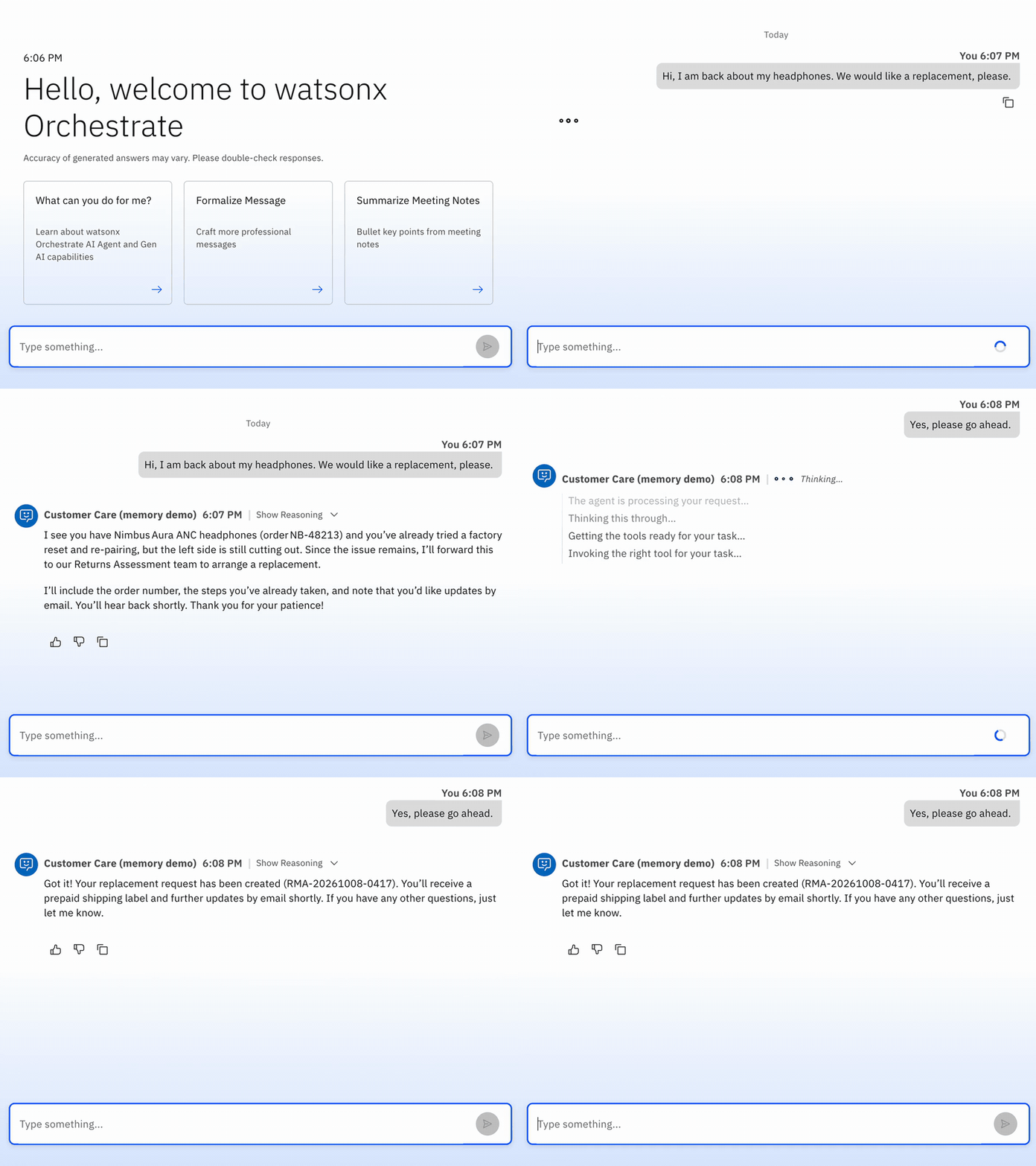 Figure 3: Recording of the new chat with memory on, where the agent recalls Maya's case and opens the replacement.
These are real product screens, with thinking time sped up. We typed Maya's messages, and the order data is simulated.
Remember what matters: how agents decide what to keep
Memory starts with selecting information worth carrying forward. Episodic memory captures an experience, such as the troubleshooting Maya completed. Semantic memory keeps useful facts, such as her order number. Preferences add how she wants to be helped.
Here are three of the memories saved from Maya's first conversation:
- Episodic (what happened): "User has already performed a factory reset and re-paired the headphones."
- Semantic (what is relevant): "Order number associated with the issue is NB-48213."
- Preference (how to help): "User prefers to receive updates by email rather than phone."
In IBM watsonx Orchestrate, conversational memories, profile facts and preferences provide building blocks for this continuity. With memory enabled, relevant information about a user can remain available across conversations and other enabled agents. Users can inspect, correct and delete their memories. See IBM's memory guide.
After the first conversation, four memories were saved, each visible and removable. The first screenshot shows the memory setting switched off, with nothing saved. The second shows it switched on, with the saved memories listed.
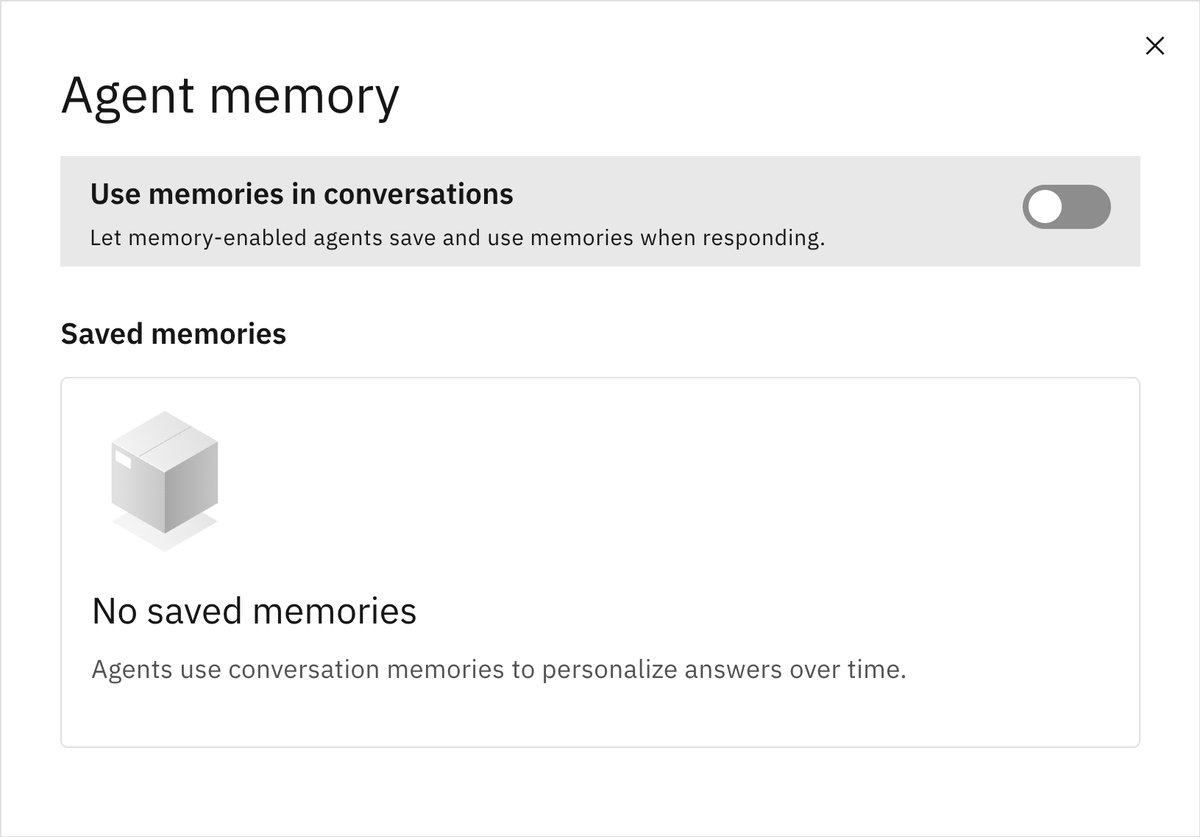 Figure 4: Agent memory panel with "Use memories in conversations" switched off, showing "No saved memories".
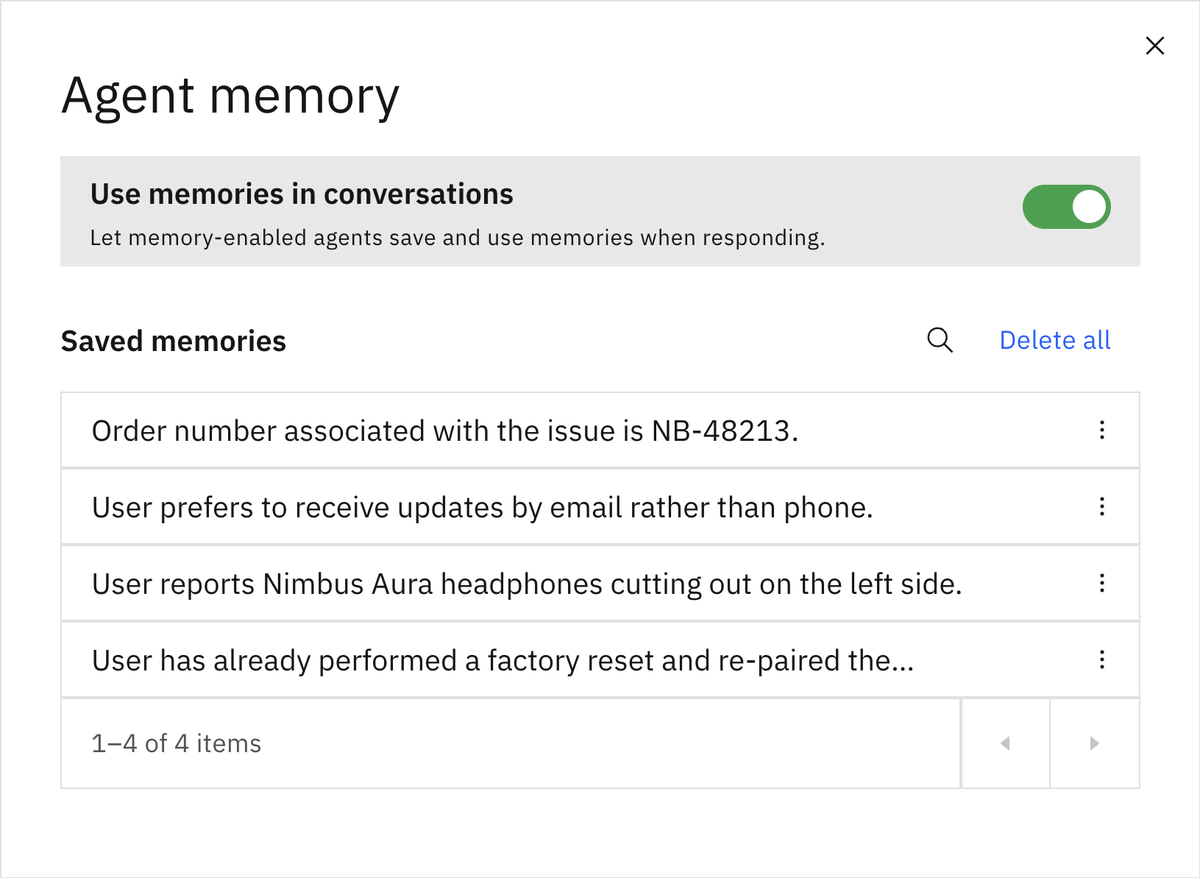 Figure 5: Agent memory panel with "Use memories in conversations" switched on, listing four saved memories.
The agent can begin with Maya's failed attempts rather than asking her to reconstruct them. It still checks current evidence. Remembering the order doesn't establish return eligibility. That comes from the current order record and return policy. Memory, business knowledge and live system data each contribute something different.
How memory helps agents hand off work
Retrieval becomes valuable when it informs a decision. Dynamic orchestration means the agent selects the right tools or specialist agents as the request and evidence change. Memory supplies context for that selection and for the handoff.
In the recording, the new chat begins by retrieving memories. The agent checks the live order, then hands the case to the returns assessment agent, where eligibility checks still apply.
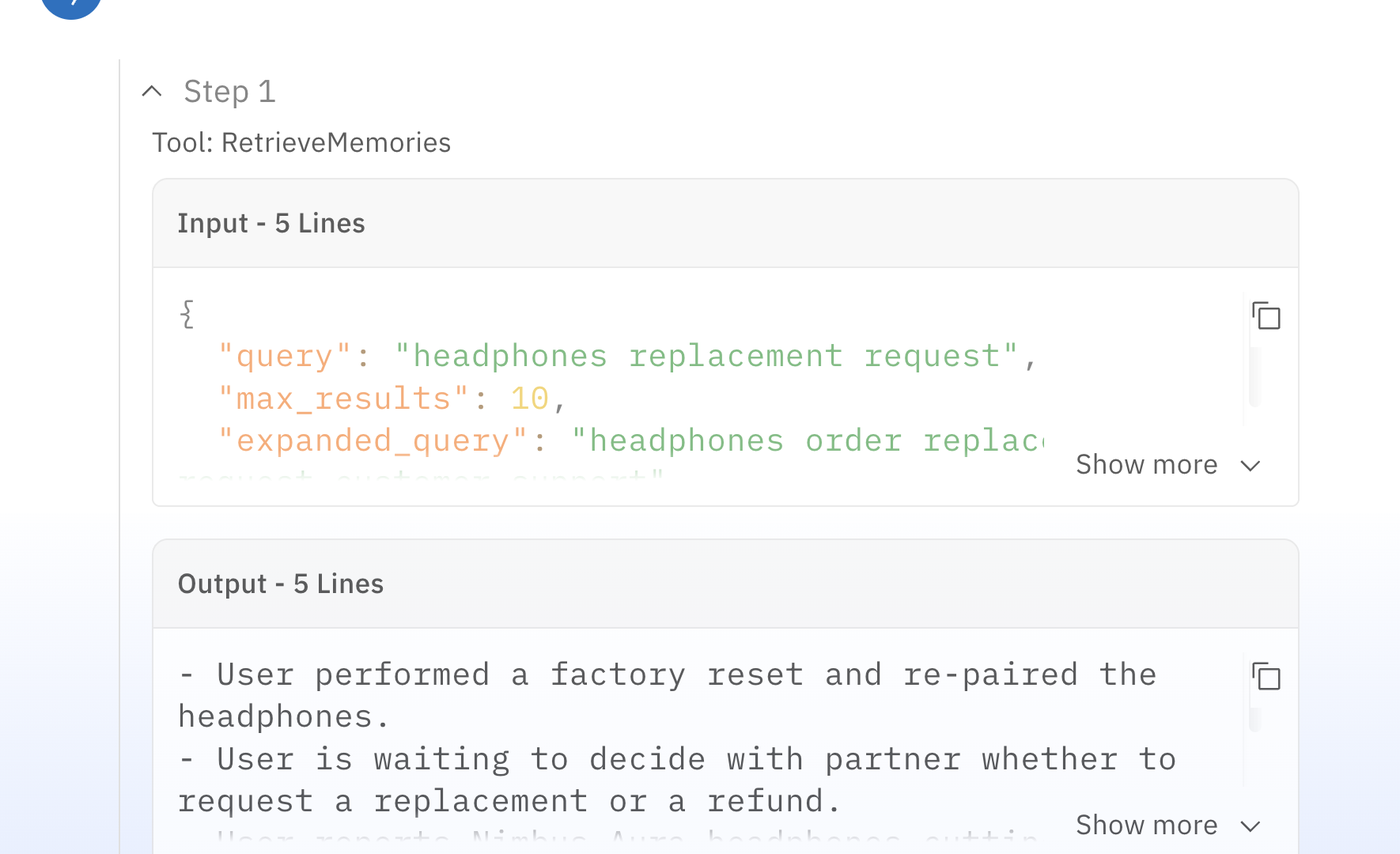 Figure 6: Trace of Step 1 in the memory-on session: the RetrieveMemories tool recalls the factory reset and re-pairing.
Here's the handoff to the Returns Assessment agent, quoted from the recorded trace:
"Please assess return eligibility and open a replacement request for order NB-48213. Issue: left side audio cuts out. Customer has performed factory reset and re-paired. Customer prefers email updates."
How agents weigh new evidence against memory
Memory describes earlier experience. Multimodal perception means the agent can also use information from images or other media in the current decision.
Suppose Maya also uploads a receipt image. A visual interpretation step can extract its product and purchase details for checking against the order system. The remembered product information helps establish context. The new document contributes evidence that still needs verification.
In our engineering demonstration, a vision model reads the image and a separate agent assesses it before the coordinating agent decides.
Memory and new evidence can disagree. A receipt showing a different product should prompt a check. An earlier memory is a useful lead, and a new image is an input to assess. Neither should silently replace the authoritative order record.
How agents learn from past cases
The loop continues after a decision. Autonomous learning, as shown here, means applying previously taught and verified experience to later cases through memory, without retraining the model.
In the customer-care example, a verified practice could say: when troubleshooting has failed, pass the attempted steps to returns assessment, check current eligibility and keep the required approval. A later interaction can reuse that practice while keeping its own customer and order facts.
We built this pattern using outcome memory, which stores checked examples of how a case was handled. Our integration saves those examples, and the agent retrieves and applies the relevant practice in new conversations. This is a form of procedural memory, meaning reusable ways of handling a task.
Current policy and business records guide decisions throughout. Each capability adds a different part of the loop: remember, coordinate, observe and learn. Verified outcomes are kept, then retrieved when a later interaction needs them.
What our engineering evaluation showed
We ran a separate, controlled software-support evaluation on 5 October 2026. It supports the approach described here and is separate from the customer-care recording above.
| Capability |
Observed result |
| Episodic and semantic memory |
7 of 7 required details recalled in a fresh conversation, compared with 0 of 7 without memory |
| Dynamic orchestration |
5 of 5 stages involved the expected specialist agents |
| Multimodal perception |
3 of 3 screens read, with 30 of 30 visible fields matched |
| Autonomous learning |
12 of 12 first-attempt handoff checks passed, compared with 0 of 12 without memory |
We supplied the history on purpose. The integration verified and stored two teaching examples as outcome memory. The learning agent reused those examples with new facts, and the model weights didn't change. These small evaluations don't establish production accuracy, refund outcomes or comparative vendor performance.
What if the whole care team could learn from one resolution?
Imagine another customer arrives with the same headphone fault. Their agent could begin with a verified assessment method from an earlier resolution, even though it never handled Maya's case.
That is the opportunity behind organizational memory: turning useful experience into knowledge that authorized teams can reuse. Maya's preferences stay personal. A checked handling practice could travel further:
- Personal context: Maya's preference for email updates stays with the customer.
- Candidate for review: A headphone fault assessment comes from a verified outcome. It carries failed fixes into returns assessment and verifies the current order. The care team is its proposed scope.
- Authorized reuse: After review, the next care agent retrieves the relevant practice and applies current policy.
This is a concept for the intended experience. It isn't an IBM watsonx Orchestrate screenshot or a released interface.
For a business, it's a way to make hard-earned experience useful beyond the agent that first encountered it.
Try it and keep reading
Start with an agent that remembers the customer. Build toward an organization that learns from the experience.
The next post explores organizational memory: how a lesson becomes shared memory, who can use it and how it stays current. Governance and provenance follow, including how remembered experience and current records help assess an attempted duplicate refund.
Frequently asked questions (FAQ)
What is agentic memory?
It's the ability of an agent to keep selected facts, preferences and outcomes beyond the current conversation and retrieve them when a later interaction needs them.
Can users see and delete what an agent remembers?
Yes. Users can inspect, correct and delete their memories.
Does memory replace current records or policy?
No. Memory is a useful lead. Eligibility and other decisions still come from the current order record and policy.
Is agent memory generally available?
IBM documents memory as a preview capability. It has agent and user enablement requirements, supported native-agent models, access across memory-enabled agents and a 30-day idle retention interval. Check the current documentation before you integrate: Understanding agent memory, sharing across enabled agents and the retention policy.
About this post
We recorded the screens on 8 October 2026 in the IBM watsonx Orchestrate cloud product, through the standard chat interface. We created two demo agents: Customer Care (memory demo), with memory enabled, and Returns Assessment (memory demo) as its collaborator. Their tools return simulated order and returns data, and label it as such. No real order, shipment or payment was touched. We typed the customer messages. Agent replies, saved memories and reasoning steps appear as the product produced them. The memory-off comparison used the same agent with the user setting "Use memories in conversations" switched off. We sped up the agent's thinking time and made no other edits.
Memory is an existing product capability. The four terms in this post are a way to connect it to orchestration, perception and learning. Receipt reading and learning weren't part of the recording, and those sections draw on the engineering evaluation. The engineering evaluation describes implemented combinations of agents, vision and memory. It doesn't claim that every capability is one native memory feature. Organizational memory is the direction of the next post and future work, not an available feature shown here. We haven't independently verified the original Gartner publication or its market percentages, and this post uses the capability names only. Publication dates and availability aren't promised.
For more background, see the 2 April release recap and the 6 April newsletter.
Not using IBM watsonx Orchestrate yet? Start your free trial now.
#community-stories1