Architecting an Open Data Lakehouse: Storage-Centric Governance and Turnkey Infrastructure with IBM Fusion
By Venkat Kolli

Building an on-premises data lakehouse often forces organizations to choose between governance fragmentation and multi-vendor operational complexity. IBM Fusion turns this challenge on its head by making enterprise lakehouse deployment as easy as 1-2-3. By combining:
1) Built-in governance enforced at the storage layer through short-lived credential vending,
2) Turnkey HCI infrastructure that deploys operational data stacks in just 24 hours, and
3) Open compatibility with any Iceberg-compliant analytics engine,
Fusion delivers a secure, cloud-native data platform entirely on your terms. As enterprises repatriate workloads from public clouds to maintain data sovereignty and control costs, IT teams require an open, unified control plane that delivers hyperscaler-grade data services without vendor lock-in.
IBM Fusion built on Red Hat OpenShift addresses this by using Kubernetes as a storage and lakehouse control plane, unifying compute, storage allocations, continuous identity chains, and metadata governance under a single architecture.
1. Storage-Enforced Credential Vending: Solving Governance Fragmentation
The Problem Statement
In traditional Data Lake & Lakehouse architectures, object storage operates as a passive bucket while security enforcement is delegated entirely to individual query engines. This decoupled security model introduces several vulnerabilities:
- Fragmented Policy Enforcement: Each query engine (watsonx.data, Presto, Spark, Snowflake) maintains its own access control lists (ACLs), user directories, and policy rules, resulting in duplicated administrative overhead and policy drift.
- Over-Privileged Storage Access: To execute queries, engines typically rely on long-lived, highly privileged S3 access keys. If an engine or pipeline component is compromised, attackers gain unrestricted access to entire underlying storage buckets.
- Storage-Level Visibility Gaps: Access controls stop at the engine layer. Physical storage objects cannot distinguish between legitimate engine queries and unauthorized data extraction, making end-to-end auditability and regional data sovereignty enforcement difficult to guarantee.
Solution Overview
IBM Fusion makes governance a built-in part of the storage platform rather than a fragmented-separate capability managed by each analytics platform. IBM Fusion provides an embedded table service featuring an industry-standard Apache Iceberg REST API interface, ensuring native compatibility across diverse enterprise query engines such as Apache Spark, Dremio, Snowflake, and watsonx.data. By standardizing catalog governance directly within the storage platform, organizations can query a single open lakehouse dataset using their preferred analytics engines without vendor lock-in or catalog fragmentation. This provides one consistent way to control data access across the organization, reducing complexity and eliminating disjointed, out of control governance.
Fusion integrates with federated enterprise identity providers (LDAP, Active Directory, OIDC, SAML) to establish a continuous identity chain. User permissions flow directly from organizational directories down to OpenShift Project tenancy boundaries, catalog policies, and Ceph S3 object storage. Storage access is dynamically granted at query runtime using short-lived, path-scoped Security Token Service (STS) credentials vended directly by the storage control plane.
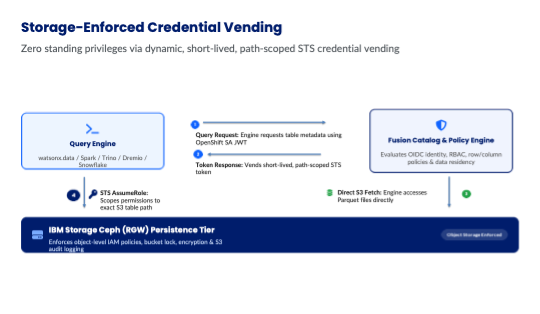
Step-by-Step Credential Vending Mechanism
- Query Request: A user or application submits a SQL query (e.g., SELECT * FROM gold_customer_sales) through any Iceberg-compatible compute engine. The engine forwards the query metadata request to the Fusion Iceberg REST Catalog alongside its OpenShift service account JSON Web Token (JWT).
- Identity & Policy Evaluation: The Fusion Policy Engine authenticates the request against the cluster OIDC issuer, resolves the caller's organizational identity, and evaluates table-, row-, and column-level security policies. Data sovereignty constraints are verified to prevent unauthorized cross-border requests.
- Short-Lived Token Issuance: Upon policy approval, the Fusion Policy Engine calls the Ceph Object Gateway (RGW) STS endpoint to generate temporary, down-scoped S3 credentials.
- Scoped Storage Execution: The engine receives these vended credentials and reads/writes only the precise S3 object paths housing the requested Iceberg table files.
- Automatic Token Expiration: The vended STS credentials expire automatically once the query completes, returning the system to a zero-trust posture.
Key Security Benefits
- Zero Standing Privileges: Query engines no longer store static S3 access keys or broad bucket-level permissions.
- Storage-Layer Guardrails: Enforcement occurs at the object layer. Unapproved engines or unauthorized cross-region requests are blocked at the storage gate before data can be fetched.
2. Turnkey Infrastructure: The Value of IBM Fusion HCI
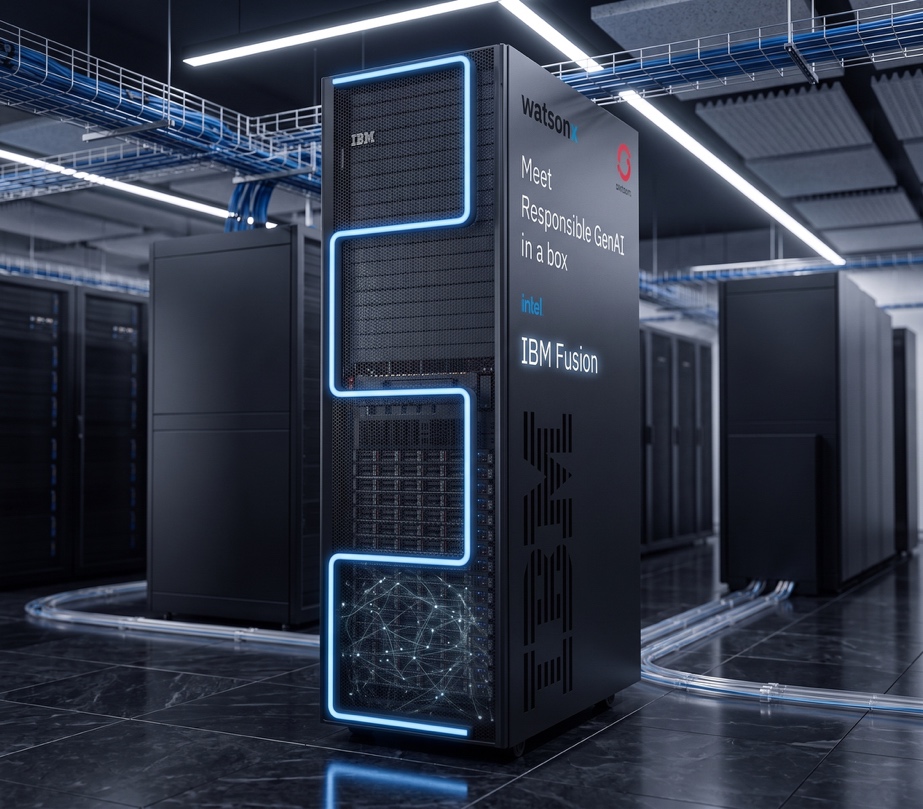
Deploying an enterprise-grade lakehouse on-premises traditionally requires custom integration of compute servers, SAN/NAS arrays, storage switches, and container platforms. IBM Fusion Hyperconverged Infrastructure (HCI) eliminates this integration complexity by providing an engineered, turnkey appliance optimized for OpenShift, virtual machines, and AI workloads.
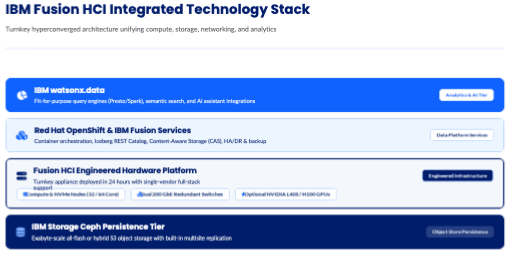
Integration of Compute, Storage, and Networking
- Engineered Appliance Hardware: Fusion HCI integrates high-performance compute/NVMe storage nodes (offering 32-core or 64-core options), dedicated 200 GbE redundant high-speed storage switches, and optional GPU expansion nodes supporting NVIDIA L40S or H100 GPUs.
- Kubernetes Control Plane for Storage: Storage allocations across block (RBD), file (CephFS), and object (RGW) tiers are managed declaratively using custom Kubernetes ResourceQuota specifications. Administrators configure storage capacity, IOPS, and network throughput limits within a single management framework.
- Separation of Ownership and Access: Fusion cleanly decouples storage data ownership from compute execution. Storage costs are assigned to dedicated tenant projects, while analytical teams execute queries within separate compute namespaces governed by independent CPU/GPU quotas.
Value for IBM watsonx and On-Premises Analytics
- 24-Hour Deployment: Fusion HCI automates watsonx.data deployment, reducing manual configuration steps from over 100 down to a single-day, automated setup.
- Bare-Metal Efficiency & TCO Reduction: Running Red Hat OpenShift directly on bare-metal hardware removes VMware/vSphere hypervisor licensing dependencies, reducing total cost of ownership (TCO) and operational overhead.
- Accelerated Query Performance: Co-engineered hardware integration and storage-level caching deliver 7x to 90x query performance improvements over traditional data setups, matching or exceeding cloud platforms like Databricks at up to 60% lower infrastructure cost.
- Unified Single-Vendor Support: Compute, networking, storage, container orchestration, and AI data software are fully validated and backed by a single support channel, eliminating multi-vendor triage friction.
- Integrated Content-Aware Storage (CAS): Fusion incorporates Content-Aware Storage services that process unstructured enterprise documents into vectorized metadata, speeding up Retrieval-Augmented Generation (RAG) pipelines and LLM inference.
3. An Open Foundation for Any Lakehouse Engine
While Fusion HCI provides an optimized appliance for IBM watsonx.data, its open table technology preview extends governance across any enterprise analytics engine.
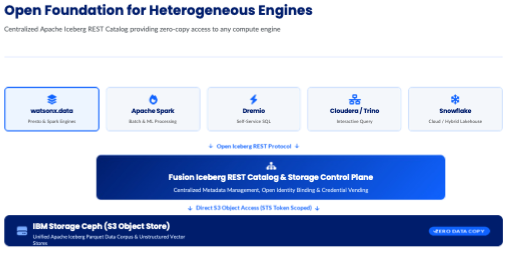
By exposing a standardized Apache Iceberg REST Catalog API directly from the storage layer, Fusion acts as a centralized metadata and credential manager for diverse data engines, including Apache Spark, Dremio, Snowflake, Cloudera, and Databricks.
Data engineering teams can run ad-hoc queries, heavy ETL transformations, and AI training models over the same underlying Ceph S3 object dataset. This approach avoids secondary data copies, eliminates data transport fees, and enforces storage-level credential vending across all compute environments.
Combining storage-enforced credential vending with IBM Fusion HCI gives organizations a secure, turnkey foundation for modern data lakehouses. Storage administrators gain centralized governance and automated infrastructure management, while data engineers can query open Iceberg datasets using their compute engines of choice.