Local LLMs and the Future of AI
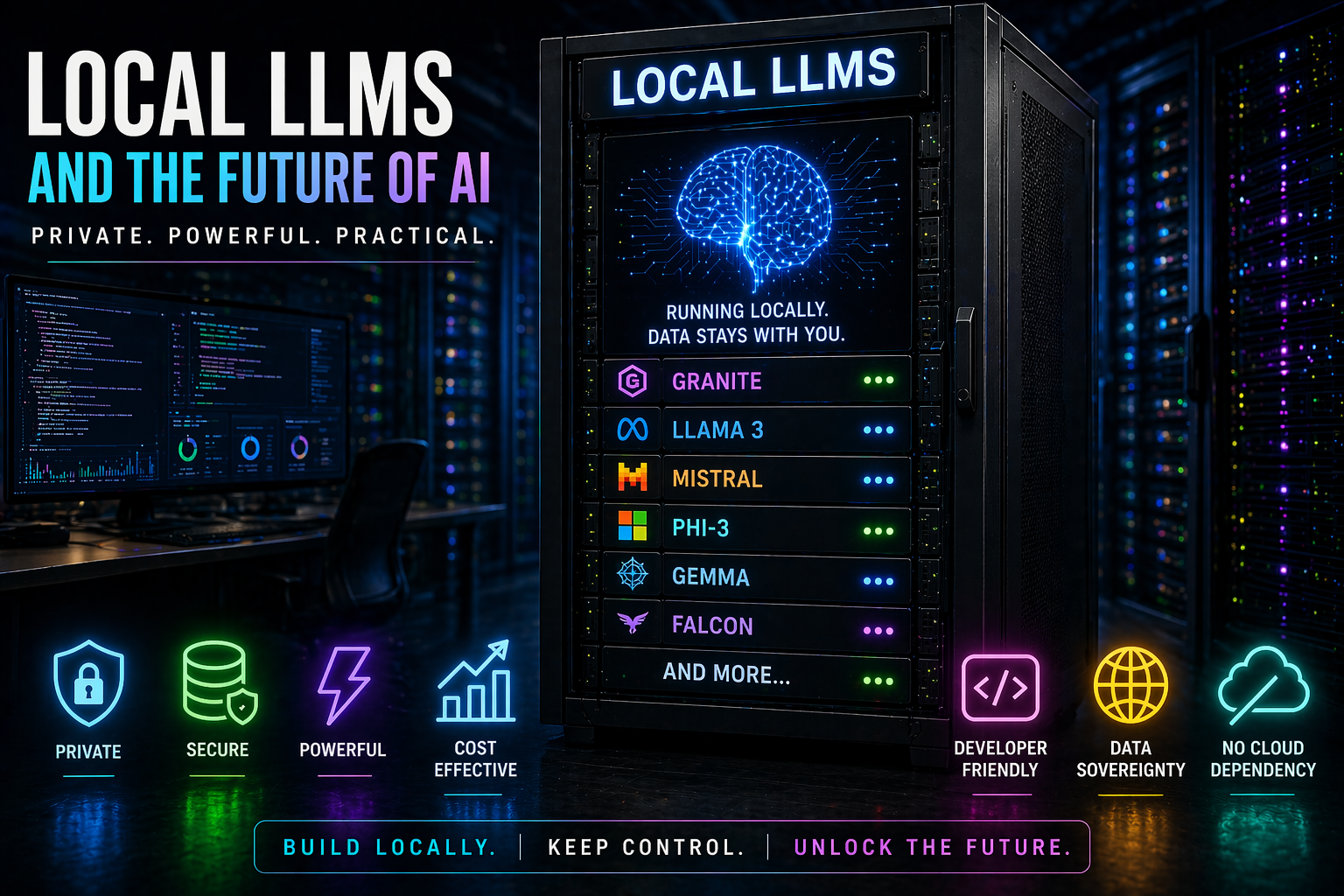
Cloud-based large language models such as ChatGPT, Microsoft Copilot, Claude, and Gemini, for all their notable capability, operate within an ecosystem that organizations do not own, cannot fully audit, and are not positioned to govern. Data traverses external networks, model behavior is dictated by third-party policies, and the fine print around training data usage continues to raise legitimate concerns in boardrooms and compliance departments alike.
Local LLMs change this equation entirely. Whether deployed on on-premise hardware or within a privately governed cloud infrastructure, a locally hosted model returns something that has quietly become one of the most valuable assets in enterprise technology control. Control over the data that flows through the model, control over how the model is configured and updated, and control over the governance frameworks that regulate its use.
This is not simply a technical preference. For industries operating under strict regulatory mandates, healthcare, finance, defense, and legal local deployment is rapidly shifting from a nice-to-have to an operational necessity.
What Are Local LLMs?
A local LLM is an AI model that lives completely within your environment, your server and your data center. No API calls going out to a third-party cloud, no data leaving the organization’s network, moreover no vendor deciding what the model can or can’t say.
When you run a model locally you own everything, the system prompt, the guardrails, the governance, and the outputs. That's a level of control that cloud-based LLMs, by design, simply cannot offer.
The Open Source Advantage:
For years the default assumption was the best models lived behind the proprietary wall and accessible only through the vendor API on vendor terms. Open source LLMs are changing this assumption fast. When the model’s architecture and weights are publicly available you are not just saving on licensing cost but gaining ability to see exactly what you are working with. For IT leaders, that means auditability. For technical teams, it means freedom to fine tune, adapt, and optimize the model for your specific use case without waiting for vendor roadmap or seeking the vendor support.
Trust is another aspect here. Proprietary models are essentially black boxes where you send the data in and get the response out, and everything in between is opaque. An open source model in contrast, allows your team to inspect the training methodology, understand the model’s tendencies and build confidence in its behavior before it ever touches production.
In regulated industries especially this transparency is not only a nice-to-have but is a prerequisite. From ownership standpoint, with proprietary models you are a tenant, pricing can change, access can be revoked, the vendor’s priorities may not align with yours. With an open source model running locally, the model is yours. You deploy it, you version it, you have full control over it.
Performance Parity:
Unlike the earlier days, the performance gap between frontier cloud models and open source LLMs is shrinking. On standard reasoning, coding, summarization, and instruction-following benchmarks the gap between open source and frontier models has narrowed to a point where the difference is not practically meaningful.
Fine-tuning is one of the key reasons this gap is closing so quickly. An open source model fine-tuned on domain specific data from your organization’s content can outperform a general frontier model on your specific tasks. Smaller, well-tuned models are consistently beating a general model on focused use cases.
Data privacy and sovereignty:
Data privacy and sovereignty are key boardroom topics in AI adoption. They are not only business and legal obligations but one that organizations cannot afford to go wrong.
When you send data to cloud based LLMs the data leaves your premises, it travels to a third party infrastructure, gets processed on servers you do not own, and sits within governance framework which you didn't design or write. For many organizations that alone is enough to disqualify cloud models from handling anything sensitive. Customer records, financial data, internal strategy documents are a few examples, none of these need to leave the building, and with local LLMs none of it does.
Data sovereignty takes this a step further. It's not just about where the data goes but about who has authority over it. Running a model locally means your data stays within your jurisdiction, within your infrastructure, and under your governance policies. That is a position you can defend in an audit, in a boardroom, and in a regulatory review.
The Economics of Local AI:
Every API call to a cloud based LLM has a price tag. At low volume that cost is ignorable, but at enterprise scale it becomes a line item that finance teams start asking questions about. This is what practitioners have started calling API tax.
The more valuable cloud-based AI becomes to your organization, the more you use it, and the more you use it, the more you pay.
A local LLM flips this model. The investment is upfront primarily in hardware and the engineering time to deploy and maintain the model. Once the local model is deployed the marginal cost of each API call is zero. You are not paying the API tax, you are not watching a usage meter. Your team can run the model as hard as your use case demands without a corresponding spike in your cloud bill.
Organizations building AI on a cloud based LLM are building on someone else’s foundation. If the vendor changes pricing, deprecates a model, or gets acquired, your workflows are at risk. Local AI gives your organization cost stability, budget predictability, and infrastructure independence that compounds in value over time.
The Developer Ecosystem:
A few years ago it was a tough job to build an enterprise scale echo system around local LLM . But that's not the case today because of a strong developers community. Today there are mature frameworks that handle the heavy lifting of model serving, inference optimization, and API compatibility. Tools like Ollama make it possible to pull a model and have it running locally in a few minutes. Frameworks like LangChain and LlamaIndex simplify building retrieval augmented generation pipelines and connecting local models to your own data. Hugging Face has become the central hub for discovering, downloading, and sharing open-source models. Tools like llama.cpp allow large models to run efficiently even on consumer grade hardware. The tooling has matured to a point where local LLM deployment is an engineering task, not a research project.
Open source AI has attracted a large and active global contributor base, Researchers, engineers, hobbyists, and enterprise practitioners, all building and improving on the same foundation. When a new architecture improvement emerges the community implements it , test it, and package it faster than any proprietary vendor could move internally. This collaborative velocity is a catalyst and is a structural advantage that closed systems simply cannot replicate.
Real -world wins:
Local LLMs are not a future promise. They are running in production today and solving real world problems across industries. The use cases are diverse, but the pattern is consistent. Organizations running their AI ecosystem on local LLMs are delivering meaningful value without the privacy tradeoffs or cost exposure of cloud-based alternatives.
In healthcare, consider a midsize hospital network that needs to summarize patient discharge notes, flag anomalies in the clinical documents, and assist physicians in drafting referral letters. None of this data can leave the hospital's network. A locally deployed model handles all of it, processing sensitive records within the organization’s own infrastructure.
In financial services, a regional bank deploys LLMs on its local infrastructure to assist compliance officers in reviewing contracts and flagging clauses that deviate from standard templates. The documents never leave the premises, and the compliance team gets a tool that cuts review time significantly without introducing regulatory risk.
In the legal sector, a law firm uses a local model for research summarization and first draft generation of routine documents. Client confidentiality is non-negotiable in legal practice, and local models make AI assistance possible without compromising that obligation.
The common thread across all these is not the technology. It is the realization that AI capability and data responsibility are not in conflict when the models are deployed on your own infrastructure.
Challenges and Limitations:
Local LLMs offer real advantages, but they also come with barriers.
On the technical side, the first reality check is hardware. Running a local model requires meaningful compute, whether a well specced on-prem server or GPU-enabled machine. The larger and more capable the model, the more infrastructure is needed. Quantization techniques help bring these requirements down. For organizations without existing on-premises infrastructure, the upfront hardware investment is a real consideration.
Maintenance is the other technical challenge that often gets underestimated. For cloud-based LLMs updates, security patches, and model improvements happen in the background by the vendor. With a local deployment, your team owns the responsibility. Model versioning, infrastructure monitoring, and keeping the deployment current are responsibilities that should be resourced properly.
On the organizational side, the skill gap is the most common obstacle. Deploying and managing local LLMs requires expertise. Finding or developing staff with these skills takes time and investment.
Local LLMs are not plug and play, but for organizations willing to make the investment, the challenges are manageable and the long term payoff is significant.
The Future of AI Is Local
The trajectory of AI is becoming clearer. Capability is moving towards opennes, infrastructure is moving towards local control, and data privacy is emerging as a non-negotiable.
Open source models are steadily closing the gap with frontier proprietary models. Community driven innovation is the catalyst in this process. As the hardware costs continue to fall and model efficiency continue to improve, the argument for sending confidential data to third party cloud-based LLMs weakens further.
Organizations that have invested early in local LLM deployment will have something their competitors do not, a mature, fine-tuned, organizationally embedded AI capability that is deeply integrated into their workflows and trained on their own data. That kind of institutional AI advantage is not something you can buy overnight from a vendor API.
The regulatory environment will also play a role. Governments and regulated industries are moving towards stronger data sovereignty requirements. Organizations that already have local AI will be ahead of that curve rather than stumbling to catch up with it.
For IT leaders, the practical implications are straightforward. The challenge is how quickly your organization can build the capability, the infrastructure, and the institutional knowledge base to make local AI a viable option.
The future of enterprise AI is not in someone else's cloud. It is in infrastructure you own, models you control, models trained with your organization's data, and data that never leaves your perimeter.