Introduction
A System Authorization Facility (SAF) keyring serves as a secure, centralized repository overseen by IBM mainframe security systems like RACF. By consolidating digital certificates and private keys for individuals or applications, it enables encrypted communication and robust authentication throughout the mainframe ecosystem.
These keyrings play a critical role in creating authenticated, secure links between distributed Host Access Transformation Services (HATS) applications—such as those on WebSphere Application Server—and backend z/OS systems, maintaining adherence to strict corporate security policies.
Deploying your HATS application to z/OS provides a distinct advantage for strengthening security: the ability to move from conventional file-based keystores, like JKS or PKCS12, to IBM SAF Keyrings. While standard keystores are stored within the integrated file system, SAF Keyrings utilize the mainframe's native security manager to safeguard private keys and certificates.
HATS Integration with SAF Keyring
Follow these steps to configure a HATS project to utilize an SAF keyring for secure z/OS communication.
-
Project Setup: Create a new HATS project, specifying the z/OS mainframe's host and secure port as 992.
-
Enable SAF Keyring Security:
-
Open the main.hco file within your HATS project.
-
Navigate to the Security tab.
-
Enable SSL and JSSE.
-
Enable SAF keyring and provide the necessary Keyring Name and Owner ID (as indicated in the below image).
-
Note that because this feature is specific to z/OS deployments, secure connection behavior cannot be tested within the HATS toolkit on Windows.
-
Deployment: Export the HATS project as an EAR file and deploy it to a HATS supported App server like Websphere Liberty server running on a z/OS machine.
-
Access: Launch the HATS application from a windows browser using the configured host, port, and project name in z/OS machine.
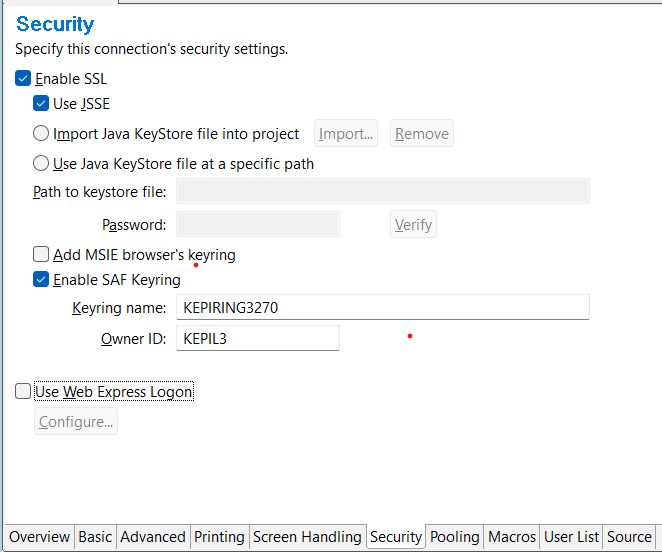
Keyring Name and Owner ID details
The Keyring Name and Owner ID are essential for securely locating the SAF keyring on z/OS. This access is vital for retrieving the certificates needed to establish an encrypted mainframe connection.
Here is a breakdown of these two components:
Keyring Name
A unique, case-sensitive identifier set during keyring creation via the RACF RACDCERT ADDRING() command.
Owner ID
The RACF user ID with administrative ownership. Applications use this ID and the Keyring Name to locate the resource and validate access.
Note:
To support either client or server authentication, depending on the security needs, the keyring must be configured within z/OS. The User ID running the application server's Java process, where HATS is deployed, needs the following permissions:
RDATALIB Class (Recommended):
FACILITY Class (only if RDATALIB is not active):
Please refer to the URLs below for instructions on creating the SAF Keyring with appropriate permissions.
https://www.ibm.com/docs/en/was-liberty/nd?topic=cslc-configuring-saf-certificates-keyrings-tls-zos-operating-system
https://www.ibm.com/docs/en/semeru-runtime-ce-z/17.0.0?topic=guide-saf
Troubleshooting
To capture detailed log statements in the z/OS Liberty server console, update HATS runtime properties file with values:
trace.HOD.TRANSPORT=3
Soumya Mallappa
HATS Developer
⚡️IBM z17 is here! Powered by the new IBM Telum II processor, IBM z17 makes more possible, empowering organizations to drive innovation and do more with their data while processing sixty percent more transactions per day than IBM z16. See what sets IBM z17 apart here.