The Mainframe Cost-Killer: Tuning IBM Z Software Asset Management with a SysProg’s Mindset and a DBA’s Backend
Every mainframe Systems Programmer and Db2 DBA knows the dread of the unexpected software audit or the monthly sticker shock of the Monthly License Charge (MLC) bill. In a complex parallel sysplex, tracking down what software is running, where it’s running, and who is executing it usually involves a mess of manual library scans, half-baked REXX execs, and spreadsheets that are out of date before they’re even saved.
Enter IBM Z Software Asset Management.
If you view IBM Z Software Asset Management as just another compliance checklist tool, you are missing out on one of the most powerful cost-management weapons in the z/OS arsenal. When architected properly—leveraging Db2 for z/OS as its data engine—IBM Z Software Asset Management transforms raw infrastructure metrics into a precise financial strategy.
Here is how IBM Z Software Asset Management takes advantage of the Db2 subsystem and z/OS systems data to kill "zombie" costs and optimize mainframe spend.
1. Purging the "CBPDO Ghost Town" (Zombie Assets)
We’ve all seen it: SMP/E target libraries filled with products that were trialed a decade ago and never deleted. Even if they aren't active in your current link list, their mere presence on an APF-authorized volume can cause a vendor auditor to trigger an "installed" flag, hitting you with a massive true-up bill.
- The Deep Dive: IBM Z Software Asset Management goes beyond static DASD scans. It utilizes low-overhead hooks to intercept SVC 1 and SVC 8 (Link/Load/Attach) execution requests. It monitors the actual execution frequency of individual load modules (LMODs) and CSECTs.
- The Value: By generating "Zero-Usage" reports against your libraries, IBM Z Software Asset Management gives SysProgs the definitive "green light" to confidently clean up SYS1.PARMLIB, prune redundant utilities (like having three different file-transfer tools), and decommission unused software. This may drop annual maintenance costs.
2. Leveraging the Db2 Subsystem (The DBA Edge)
IBM Z Software Asset Management doesn't lock your asset data into a proprietary, clunky flat-file database. It treats your metadata like the enterprise-grade resource it is by hosting it natively inside Db2 for z/OS.
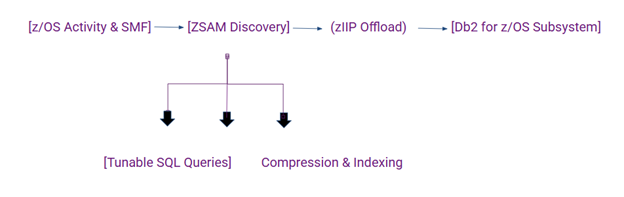
- The Deep Dive: Because IBM Z Software Asset Management populates standard Db2 tables, a DBA can actively tune the asset repository. You can apply standard Buffer Pool tuning, advanced data compression (like Zstandard or Huffman), and custom Indexing to keep the performance blazing fast and the DASD footprint minimal.
- The Value: You aren’t trapped by canned reports. Because it’s a relational database, you can write recursive CTEs and custom SQL queries to join IBM Z Software Asset Management discovery tables directly with your internal corporate chargeback applications.
3. Harvesting SMF for Forensic Cost Analysis
To get a handle on Tailored Fit Pricing (TFP) or Sub-Capacity licensing, you need high-integrity data. IBM Z Software Asset Management continuously correlates its discovery engine with the system source of truth: System Management Facilities (SMF).
- SMF Type 30 (Address Space Statistics): IBM Z Software Asset Management analyzes Type 30 records to pair software module execution with job names, user IDs, and account codes. You can see exactly which business unit executed a high-cost compiler.
- SMF Type 70-79 (RMF/CMF Performance Data): By correlating asset execution with RMF metric windows, you can pinpoint exactly which third-party software products are spiking your 4-Hour Rolling Average (4HRA) during peak processing times.
- SMF Type 89 (Usage Data): IBM Z Software Asset Management leverages Type 89 records to cross-reference what your system officially reports to IBM for Usage License Billing against what is actually sitting active in your production libraries.
4. Absolute Precision via LPAR-Level Granularity
In a shared DASD and shared PROCLIB environment, "License Creep" is a constant danger. A product authorized for a single 100-MSU development LPAR can easily be executed on a 1,000-MSU production LPAR, causing an accidental—and ruinous—licensing breach.
- The Deep Dive: IBM Z Software Asset Management tracks asset residency versus active execution at the strict LPAR level. It monitors the distinct LINKLIST and STEPLIB concatenations per image, ensuring that shared volumes aren't leaking software access across sysplex boundaries.
- The Value: This granularity is vital for protecting your Sub-Capacity boundaries and leveraging Mobile Workload Pricing (MWP) or ZCAP. IBM Z Software Asset Management provides the timestamped relational evidence required to demonstrate to auditors that a workload was safely isolated to its designated capacity group.
5. Achieving MIPS-Neutrality via zIIP Offloading
The ultimate irony of many mainframe "cost-optimization" tools is that they consume so much general-purpose CP overhead that they end up driving up your 4HRA baseline. IBM Z Software Asset Management is architected specifically to avoid this trap.
- The Deep Dive: IBM Z Software Asset Management's data processing routines execute via SRB (Service Request Block) modes that are heavily zIIP-eligible. Because it talks directly to Db2 for z/OS, the database interactions can also be offloaded to specialty engines through the Distributed Data Facility (DDF) or local optimization paths.
- The Value: You get granular, continuous software asset transparency without the management tool itself inflating your monthly IBM bill.
The Verdict: A Virtuous Cycle
For the SysProg and the DBA, IBM Z Software Asset Management isn't just administrative overhead—it’s an infrastructure defense mechanism. By marrying the structural power of Db2 for z/OS with the systemic integrity of SMF data and LPAR monitoring, IBM Z Software Asset Management creates a virtuous cycle.
The efficiency of the Db2 backend keeps the cost to run the tool low, while the insights delivered by IBM Z Software Asset Management keep your overall software licensing fees even lower. It’s the ultimate way to hand your CFO a data-backed infrastructure strategy instead of a massive bill.
Key Takeaways for the Technical Team
- Stop Guessing: Use SVC execution tracing ( IBM Z Software Asset Management) instead of PDS/PDSE directory dates.
- Own the Data: Write your own SQL joins against the IBM Z Software Asset Management Db2 tables to build custom internal audit reports.
- Protect the Peak: Use LPAR tracking to align software execution with your lowest-cost 4HRA windows.
________________________________________________________________________________________________________________________________
The tech that runs the world doesn't run on hype. Join IBM Z Skills Fest (3–7 August) to explore real-world tech careers, build in-demand skills, and earn digital credentials that set your resume apart. Free, virtual, and live-streaming from your computer.
Sign up: ibm.biz/skillsfest2026-registration
#IBMZSkillsFest