As enterprises rapidly deploy AI agents, many existing long-running, business processes are becoming augmented with agent-driven tasks and decision points. Yet, this is often occurring in an ad hoc manner, where agents are layered onto existing processes without rethinking the broader workflow. As autonomous capabilities become more pervasive across the enterprise, organizations have an opportunity to establish the governance, observability, and process alignment needed to help these systems scale effectively and deliver sustainable value.
Why agentify business processes?
Agentification transforms existing business workflows by introducing AI agents that can reason, take actions, and collaborate with people. Rather than replacing processes, it enhances them with intelligent automation, adaptive decision-making, and greater operational efficiency.
Figure 1. Sample business process before agentification
Take for example, a legacy business process shown in Figure 1. Some steps may already be automated, while others still require significant manual effort. Agentification introduces intelligent, autonomous capabilities into selected process activities, enabling work to be executed, coordinated, and optimized more dynamically, as shown in Figure 2.
Figure 2. Sample business process after agentification
The business process remains the backbone of the workflow, commonly represented using Business Process Model and Notation (BPMN). AI agents become additional process participants, collaborating alongside people, business rules, and traditional automation.
Augmenting the business process with agents enables organizations to:
-
Automate complex, knowledge-intensive tasks
-
Reduce manual work and exception handling
-
Introduce flexibility into workflows
-
Augment human decision-making
-
Extend automation to previously impractical activities
Who can benefit from agentic workflow transformation?
Agentification can benefit process owners, business analysts, operations teams, managers, and automation teams involved in business workflows. It is especially valuable for roles that spend significant time on repetitive tasks, investigations, exception handling, information gathering, and decision preparation. By introducing agents into selected process steps, organizations can improve process efficiency, and allow people to focus more on judgment, approvals, and higher-value work.
Path to Augmentation of Business Processes with Agents
For decades, organizations have improved business processes through documentation, optimization, and automation. Yet many workflows remain fragmented across applications, emails, spreadsheets, and human decisions. The process organizations believe they run often differs from the process that actually executes.
Most organizations operate with three versions of every process:
-
The designed process documented in BPMN models, standard operating procedures (SOPs), and governance documents.
-
The perceived process employees believe they follow.
-
The executable process that actually unfolds across applications, emails, meetings, approvals, and human decisions.
Consider an insurance claims process. The official workflow may show a clean sequence of activities and approval paths. In reality, claims adjusters exchange emails, consult experts, use spreadsheets, follow local practices, and apply exceptions that never appear in formal documentation. Such variations contribute to the well-known "spaghetti" [1] distribution of execution traces, causing a long tail of process executions variants that cannot be effectively addressed within the strict scope of current process systems. The process delivering business outcomes often looks very different from the process everyone believes exists. This gap creates real business challenges. Organizations lose visibility, critical knowledge becomes trapped in informal workflows, and modernization efforts frequently automate outdated assumptions instead of addressing how work is actually performed.
Building a Digital Process Twin
Before a process can be transformed, it must be understood. We use the concept of a Digital Process Twin: a continuously evolving representation of how work actually happens across systems, people, documents, communications, and business decisions. Rather than relying on static process maps that become outdated, the Digital Process Twin continuously learns from:
Why Agentic Business Process Management (BPM) is different
Traditional automation asks: How can we execute this process more efficiently? Agentic BPM introduces a different question: What is the best way to leverage agents in your workflows to achieve the desired business outcome? Unlike traditional workflow systems that execute predefined sequences, agents can reason about goals, gather information from multiple sources, coordinate actions, adapt to changing conditions, and operate within organizational policies.
Imagine a procurement approval process. Today, a request may move through multiple systems, approval chains, and email exchanges before a decision is made. An intelligent agent could evaluate policy compliance, collect supporting information, automatically approve routine requests, flag anomalies, and escalate only exceptions that require human judgment. The focus shifts from routing transactions through a workflow to achieving the outcome quickly and safely.
We propose an approach that employs Agent0, which discovers how work is actually performed, while Agent1 transforms and governs that work as an agentic business process, shown in Figure 3.
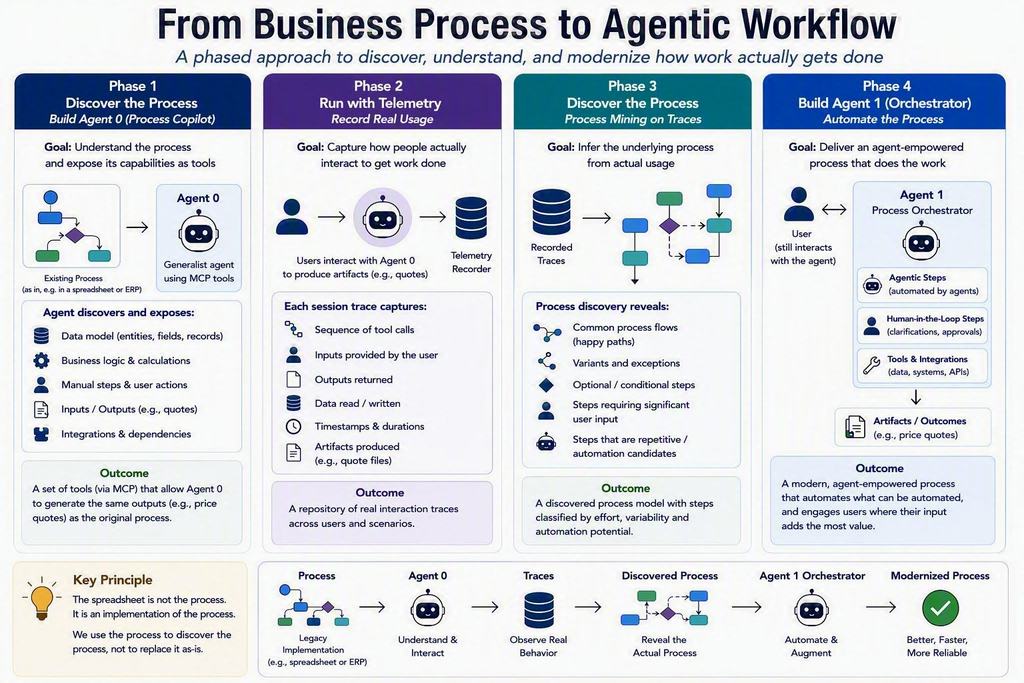
Figure 3. Approach for process discovery and transformation to an agentic workflow
Agent0: Discovering the Process Nobody Can Explain
Before an enterprise can redesign a business process with AI, it has to answer a basic question: how does the process actually work today? In many organizations, that answer is surprisingly hard to find. The official process map may be outdated. The documentation may describe only the happy path. The subject matter experts may have moved on. And the real operational logic may be spread across documents, spreadsheets, legacy applications, APIs, microservices, configuration files, user actions, and years of accumulated workarounds.
This is the discovery problem Agent0 is designed to solve. Agent0 is not just trying to read documentation or summarize an existing process diagram. It is designed to uncover the executable reality of a process: the version of the process that actually runs inside the enterprise. That includes the rules, dependencies, exceptions, system behaviors, and user actions that determine how work really gets completed.
Agent0 focuses on four discovery challenges that are especially difficult to capture manually:
- Hidden approval logic: Many approval rules are never written down clearly. They may be embedded inside applications, spreadsheets, service logic, or configuration settings. Agent0 can vary inputs and observe outcomes to infer how approval decisions are actually made.
- Exception paths: Real processes rarely follow only the standard path. Edge cases, failed validations, missing data, escalations, and manual overrides often define how the process behaves in practice. Agent0 can explore these paths by testing different scenarios and observing how the system responds.
- Legacy-system behavior: In many enterprises, important process knowledge is buried inside older applications or systems that few people fully understand. Agent0 can explore those systems, follow workflow paths, observe interactions, and reconstruct the operational knowledge that has been lost over time.
- Discovery without SMEs: Traditional discovery often depends on interviews with subject matter experts. But experts may be unavailable, or their knowledge may be incomplete. Agent0 can continue discovery by executing process steps, capturing traces, and learning from system behavior directly.
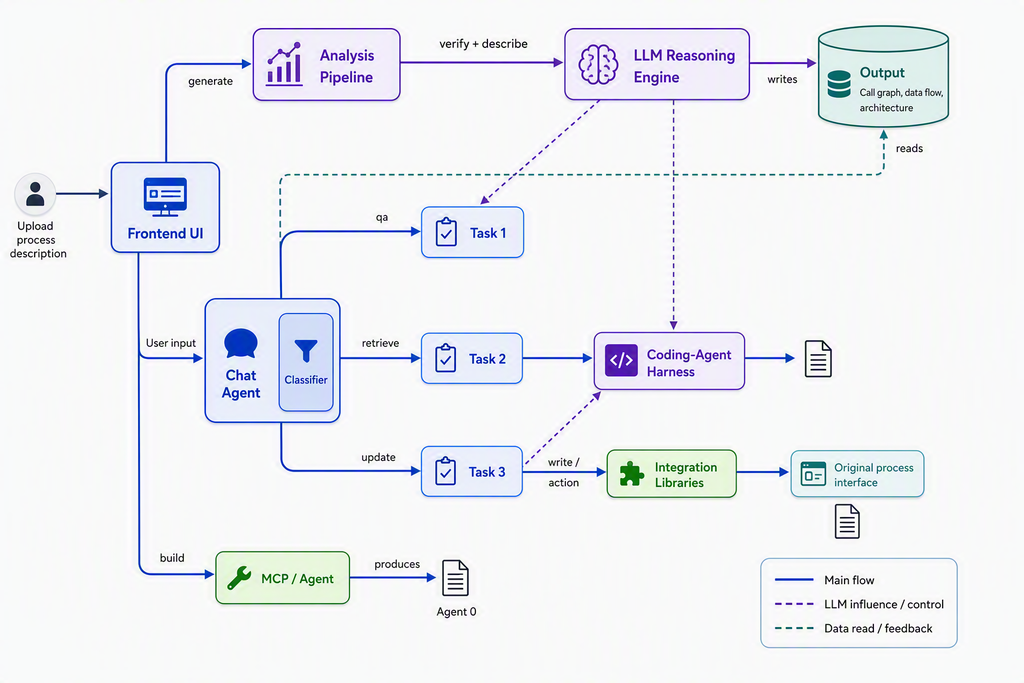
Figure 4 Approach for building Agent0 to uncover hidden process behavior and expose discovered capabilities through an agent interface for questions, retrieval, updates, actions, and tool generation.
Figure 4 shows how Agent0 turns this discovery problem into a generic architecture. Process evidence can come from many sources: documents, spreadsheets, application screens, APIs, logs, microservices, existing enterprise systems, and user or system interactions. Agent0 collects this evidence through a frontend or integration layer and passes it through an analysis pipeline. The reasoning layer then identifies workflows, data flows, decision points, integration points, and possible actions. Together, these become a process knowledge model — a structured representation of how the process works, what systems it touches, what data it depends on, and what actions can be performed.
Agent0 then exposes this discovered process through an interactive agent interface. Users can ask questions about the process, retrieve specific information, inspect workflows, or request approved actions. When needed, a coding-agent harness can generate orchestration logic or executable tools based on the discovered process structure. In this way, Agent0 is not only a documentation assistant. It becomes a discovery and execution layer over the existing enterprise process.
The result is a foundation for a Digital Process Twin: a living model of how work actually happens. Once Agent0 has reconstructed the current process and exposed its capabilities, the organization can analyze, simulate, validate, and eventually transform that process with more confidence. Agent0 therefore plays a critical first role in the larger agentic BPM vision: it discovers the real process before higher-level agents attempt to optimize or redesign it.
Agent0 Example
For an employee onboarding process, the architecture analyzes onboarding documentation and workflows, identifies required systems and actions, and generates a process knowledge graph. The resulting Agent0 can answer onboarding questions, retrieve employee status, provision access, create tickets, and interact with HR and IT systems through integrations. This provides a working agent that automates key onboarding tasks and serves as the foundation for more advanced autonomous process execution.
From enacted work to an executable flow: A play-in / play-out route
Discovery alone is insufficient. Once Agent0 has captured how work is actually performed, the resulting traces must be transformed into an executable process representation that can be governed, simulated, and evolved. This is the purpose of Phase 3. Process discovery (Phase 3) asks what process actually runs beneath the everyday work Agent0 observes. Phase 3 answers it with a play-in / play-out approach [2] in which a stakeholder plays in the behavior they want by demonstrating it directly on a running interface (e.g., Agent0), and the tool then consolidates these behavioral observations into a runnable artifact, namely the plays out model.
Phase 3 captures the 'shape of the flow' and the changes where the behavior comes from. The people doing the work play in the routine simply by doing their jobs alongside Agent0, which records each interaction with the underlying applications — what was retrieved, what was changed, what was run, in what order, and which way the work went at each point where it could have gone more than one way. Those traces are the raw play-in. A process analyst then plays in intent on top of the discovered skeleton — consolidating variants, naming branches, marking which values a person must supply, and stating how routing should be decided. The consolidated, annotated flow is played out as an execution-ready articulation that Agent1, realized by CUGA FLO alongside a workflow engine, can orchestrate. It is a working slice of the Digital Process Twin for one routine: its shape, its inputs, its decisions, and the places it must still ask a human.
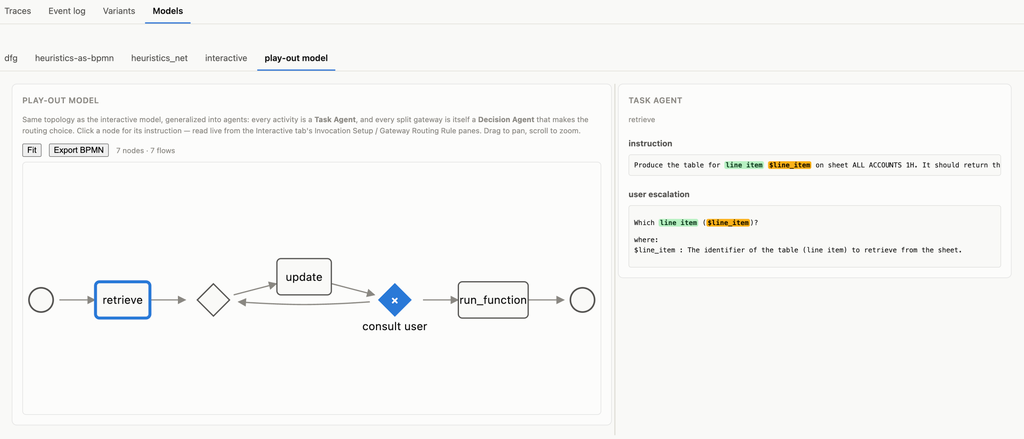
Figure 5. Play-out model
Structural visibility: consolidating the variants
Real usage has a long tail. The same routine is carried out many slightly different ways, and the "spaghetti" of individual traces hides the routine that everyone would recognize. Phase 3 mines the recorded traces into a single high-level flow and, next to it, the complete set of distinct paths through that flow — ranked by how often each occurred, each linked back to the cases that followed it. An analyst can see at a glance which paths are the routine and which are exceptions, fold the near-duplicates together, and re-derive the flow from only the paths that matter. This is how a wall of traces becomes an agreed picture of the work: its frequent flows, its alternating routes, and the points where it legitimately forks.
Interactive elicitation: inputs and routing decisions
A high-level flow is only useful if it is clear, step by step, what a person must
provide and how the flow chooses its path.
-
Input parameters. For each task, phase 3 generalizes the many concrete instructions it was historically given into one parameterized template and classifies every parameter as genuinely variable that must be supplied when the flow runs, i.e. a user input, versus fixed, a constant value. The analyst reviews and adjusts this interactively, and the flow ends up stating its own information needs rather than leaving them implicit in past examples.
-
Routing decisions. At every point where the discovered flow forks, trace mining tries to articulate the routing logic from the observed branching. The analyst names each outgoing branch and can apply, edit, or reset the routing policy, moving from "this is where the flow forked historically" to "this is the routing we intend to automate." Forks that stay unruled are explicit points of human consultation: the running flow will have to ask.
Playing it out: evolving toward an agentic flow
The played-out model recasts the discovered flow in the terms CUGA FLO already uses: Task Agents for activities and Decision Agents for routing points, each carrying the instruction it would execute and the escalation it would raise to a person when it lacks an input it needs. Exported as a standard BPMN model, it hands Phase 4 a concrete starting point rather than a blank canvas. Because the model keeps labeled activities, routing points, and plain sequencing and joining separate, it is clear which elements are candidates to become agents and which should stay as deterministic control run by the workflow engine. Phase 3 does not make that call. It surfaces the structure that lets CUGA FLO make it deliberately, element by element, as an automatically mined flow evolves into a governed agentic process.
Agent1: From Understanding Work to Augmenting Agents into Business Processes
Once a Digital Process Twin exists, a bigger opportunity emerges to change how outcomes are achieved with an agentified workflow system that integrates outcome-based work fulfillment with high-level steering that is sustainable to a large variety of environmental dynamics.
Agent1 is the process-level agent, realized by CUGA FLO [3][4], shown in Figure 6, together with a workflow engine, that interprets, coordinates, and governs the execution of business processes. CUGA FLO is the process harness that provides the agentic oversight layer around workflow execution, connecting process logic with task agents, decision agents, and user-facing interactions. Agent1 integrates with Agent0 to connect this process-level intelligence with the user’s actual working environment: Agent0 provides the interaction traces from which genuine operational processes can be discovered and learned, while Agent1 uses these process representations to coordinate and govern execution. During runtime, Agent1 delegates concrete tasks and requests for user input back to Agent0, which carries them out through the applications and interfaces available to the user. This creates a closed loop in which observed work informs process models, and those models subsequently drive and oversee real execution through the same user-facing environment.
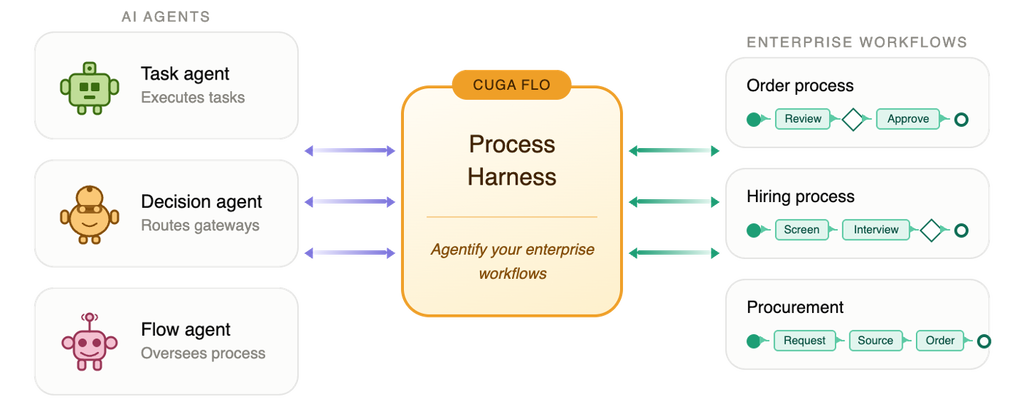
Figure 6. CugaFLO Overview
For example, in a sales-planning process, Agent0 may capture how a planner actually works across spreadsheets and business applications—retrieving prior-quarter sales, adjusting account forecasts, and running validation macros—thereby producing traces that reveal the real planning process. Agent1, realized by CUGA FLO together with a workflow engine, can use that process structure to coordinate and govern future planning runs: CUGA FLO provides the process harness and agentic oversight, while the workflow engine manages execution state and sequencing. During execution, Agent1 may ask Agent0 to retrieve the current forecast from a specified sheet, update an approved value, invoke a validation macro, or ask the planner which scenario or account grouping should be used, thereby connecting process-level control with the actual work performed in the user’s environment.
Business Benefits of Agentic BPM
By combining process intelligence with autonomous AI agents, Agentic BPM enables organizations to modernize legacy processes more rapidly, reduce reliance on tribal knowledge, improve compliance and governance, increase operational transparency, accelerate AI adoption, and create resilient operations that can continuously adapt to change.
Toward Agent-Native Operations
Enterprise transformation is entering a new phase. Rather than simply automating predefined workflows, organizations can now discover how work is truly performed, build living Digital Process Twins, and progressively introduce agentic capabilities that operate alongside people. By combining process discovery through Agent0 with orchestration and governance through Agent1 and CUGA FLO, enterprises can evolve toward agent-native operations while preserving governance, transparency, and business control. The result is a continuous transformation cycle in which processes adapt, learn, and improve alongside the business itself.
In traditional BPM systems, humans act as the integration layer between applications, information, and decisions. In agent-native operations, agents increasingly assume responsibility for coordination, monitoring, and routine execution, while humans focus on governance, creativity, strategy, and judgment. To support this vision of Agentic BPM [5], we explore innovations for process discovery and CUGA FLO, enabling organizations to incrementally introduce agentic capabilities into existing workflows without replacing their workflow infrastructure.
Transformation is not a one-time redesign but an ongoing cycle of observing operations, discovering opportunities, reimagining workflows, governing change, and learning from outcomes. As processes, business priorities, regulations, and AI agents evolve, organizations can continuously adapt and expand agentic capabilities to drive sustained business transformation.
The future of process transformation is not simply automation. It is the creation of enterprises in which agents and humans collaborate within governed operational systems that continuously learn, adapt, and improve. By combining process discovery, Digital Process Twins, and Agentic BPM, organizations can move beyond isolated AI deployments toward sustainable agent-native operations.
Authors: Yu Deng, Fabiana Fournier, Harshit Kumar, Lior Limonad, Rangeet Pan, Raju Pavuluri, Yara Rizk, Maja Vukovic
References:
-
Aalst, Wil van der. "Process mining: data science in action." (2016). Springer, Berlin, 2nd edition.
-
Harel, D., Marelly, R. *Specifying and executing behavioral requirements: the play-in/play-out approach.* Software and Systems Modeling 2, 82–107 (2003). https://doi.org/10.1007/s10270-002-0015-5
-
Fournier, Fabiana, and Lior Limonad. "A Process Harness for Uplifting Legacy Workflows to Agentic BPM: Design and Realization in CUGA FLO." arXiv preprint arXiv:2606.27188 (2026).
-
CUGA FLO open-source repository: https://github.com/cuga-project/cuga-flo/branches
-
Calvanese, Diego, et al. "Agentic business process management: a research manifesto." Information Systems 140 (2026): 102738.