IBM Master Data Management (MDM) 2.4 delivers a focused set of capabilities designed to strengthen governance and security and give stewards and data teams more control and insight. This release focuses on reducing manual effort, improving confidence in AI‑driven decisions, and empowering stewards with intuitive tools.
Below is a tour of what’s in 2.4 and how it helps your teams:
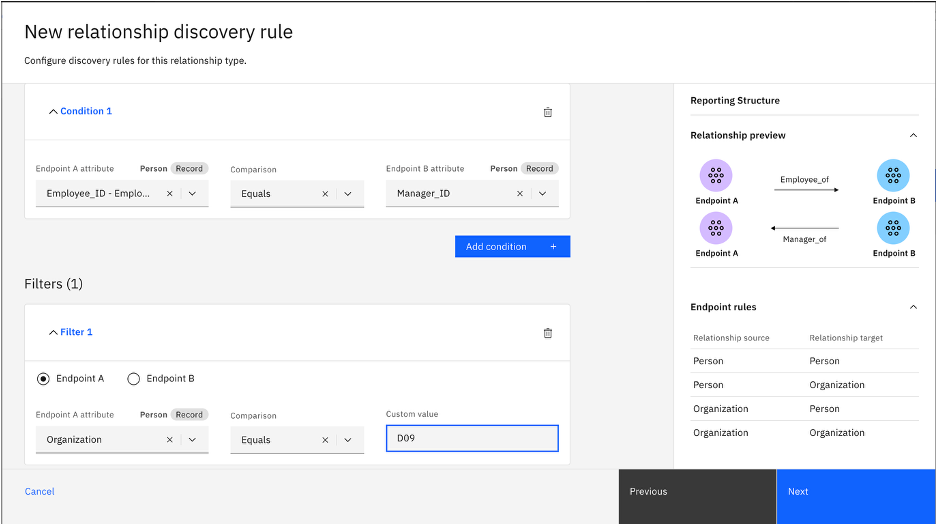
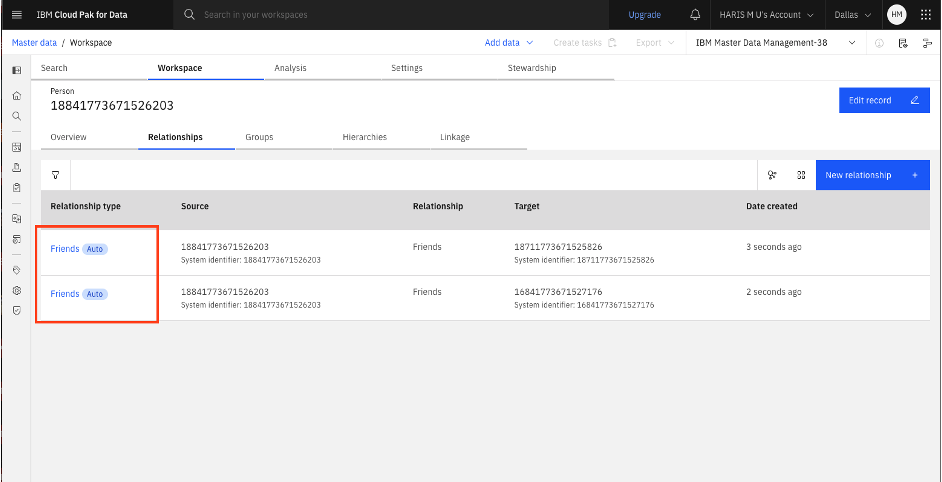
1. Discover relationships at scale with Relationship Discovery Rules
Relationship Discovery Rules enable organizations to automatically discover and maintain logical connections between records and entities using rule‑based automation. This capability ensures relationships are defined, governed, and maintained consistently as data evolves. It includes:
This allows organizations to uncover and maintain meaningful data relationships automatically, improving insight while significantly reducing manual effort.
2. Stronger security with role, attribute, and token-based access control
As master data is shared more broadly across the enterprise, controlling who can see and act on that data becomes increasingly critical. This feature introduces enhanced role, attribute, and token‑based access control to deliver fine‑grained, data‑level governance without sacrificing usability.
These enhancements include:
-
Action‑level permissions that define which users can view, edit, delete, or perform bulk operations, by data type.
This ensures the right users have the right access to the right data, strengthening governance while enabling secure, enterprise‑wide adoption of master data.
3. Smarter matching with machine learning and pair review enhancements
Machine learning and pair review enhancements in IBM Master Data Management introduce additional transparency, guidance, and stewardship alignment into the matching experience. These improvements make it easier to understand how matching decisions are made, adjust thresholds with confidence, and continuously improve outcomes based on real steward behavior.
New capabilities include:
-
Intuitive, reactive visualizations that provide clear breakdowns of thresholds, match outcomes, and score distributions for improved explainability.
This helps organizations increase match accuracy and consistency by combining explainable AI with steward expertise, reducing false decisions and accelerating trust in mastered data.
4. More flexible survivorship with value-based compositing
Value‑based compositing extends IBM MDM survivorship by introducing flexible, value‑level logic for how attribute values are selected and mastered. This capability allows organizations to define more nuanced and business‑relevant rules, so the most meaningful data survives into end entities, even when multiple records contribute competing values.
With this release, IBM MDM introduces:
-
Value‑level survivorship controls that govern how selected attribute values from source records survive into mastered entities, including value comparison, value priority, and conditional value‑based sorting logic.
-
Expanded compositing logic that builds on existing source, frequency, and last‑update date survivorship to support richer, context‑aware outcomes.
-
Intuitive rule builder, controlled by attribute and data type, enabling domain‑specific survivorship logic and unique, business‑aligned views of mastered data.
This reduces manual intervention while giving stewards greater control over how mastered data is formed.
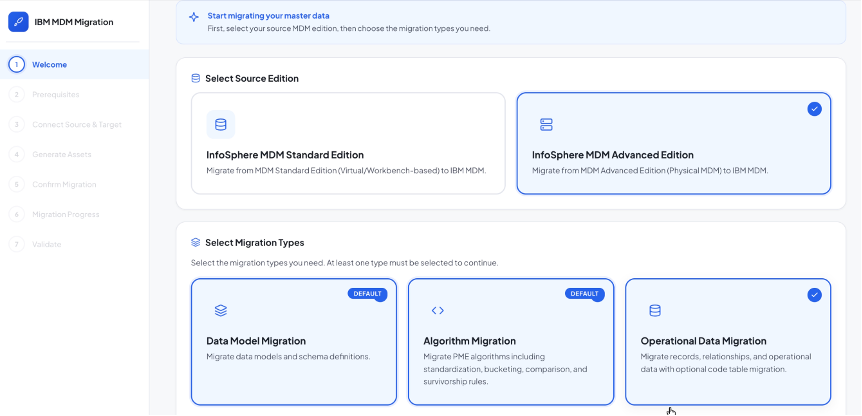
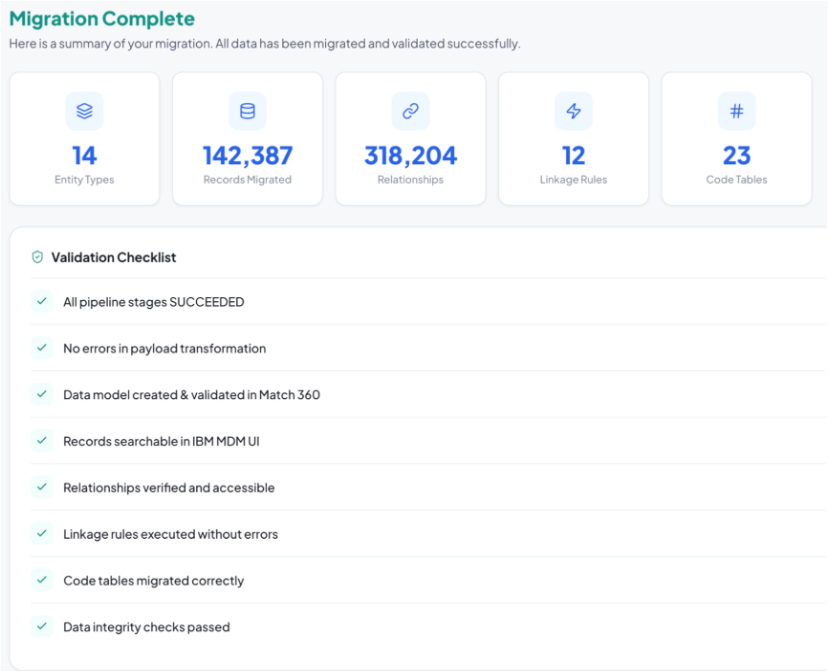
5. Accelerate modernization to IBM MDM with new Migration UI
Take advantage of your existing investments in IBM InfoSphere Master Data Management Standard Edition and Advanced Edition while modernizing to the ML-powered, cloud native IBM MDM with an intuitive step-by-step process and feedback. The new migration tool simplifies the transition to the modern platform by:
This guided, UI-driven experience removes much of the risk and complexity associated with legacy modernization.
6. Improved steward productivity with enhanced task management and tagging
Stewardship enhancements focus on improving how master data tasks are organized, accessed, and resolved within the MDM experience. These updates streamline task handling and help stewards stay focused by reducing context switching and making it easier to identify and prioritize work that requires attention.
New stewardship enhancements include:
-
Seamless navigation across search, workspace, analysis, and stewardship, keeping stewards centered in one interface.
-
Advanced task tagging, enabling stewards to categorize, segment, and prioritize tasks based on business needs.
This helps stewards resolve issues faster and more effectively, improving data quality while reducing operational friction.
IBM Master Data Management 2.4 is about scaling trust with confidence, automating where it adds the most value, strengthening governance without adding friction, and empowering teams with clearer insights and better tools. Whether you’re discovering and maintaining relationships at scale, fine‑tuning AI‑driven matching with explainability, enforcing precise access controls, or accelerating modernization from InfoSphere MDM solutions, these enhancements are designed to reduce manual effort while increasing accuracy and control. Combined with improved stewardship workflows that keep users centered in the MDM experience, IBM MDM 2.4 helps organizations move faster with reliable master data and turn data complexity into a competitive advantage.