Imagine a Product Manager at FreshBite Global preparing to launch Protein Crunch, a new breakfast cereal, in Germany. The product formulation is finalized, commercial projections look promising, and market entry is within reach.
Yet before giving the final green light, the manager must answer six fundamental questions:
- Can the product be legally marketed as "High Protein" under European regulations?
- Does its nutritional composition satisfy exact local regulatory thresholds?
- What are the German-specific labeling and allergen requirements?
- How have similar products performed in the German market?
- Has FreshBite successfully launched a comparable product in another region?
- How do competing products perform within this exact category?
None of these questions are unusual, but answering them requires information scattered across disparate domains: structured product data, regional sales metrics, unstructured regulatory PDFs, and organizational knowledge.
Today, getting these answers requires weeks of manual coordination across regulatory specialists, commercial analysts, R&D, and regional business units. Multiply this friction across hundreds of product launches in more than 70 countries, and decision making quickly becomes a slow, expensive bottleneck.
The problem is not whether FreshBite has the data. Snowflake serves as FreshBite's Enterprise Data Platform, acting as the strategic foundation for enterprise analytics, governed data sharing, and AI innovation. The real challenge is: How can FreshBite unify this data and institutional knowledge to drive faster, more consistent launch decisions without repeating manual effort across regions?
Assessing the Landscape: The Limits of Existing Models
To solve this, organizations typically evaluate three distinct approaches within their enterprise ecosystem:
- Traditional Analytics: Highly effective for tracking established KPIs (such as product specs, revenue, and volume across channels) via fixed dashboards. However, they are inherently rigid. Addressing new, cross-functional questions requires continuous IT pipeline modifications.
- Self-Service Analytics: Empowers business users to explore structured tables using semantic models and natural language interfaces. While flexible, it remains strictly limited to structured data and requires continuous maintenance to reflect changing business logic.
- Enterprise AI (Agentic Orchestration): Dynamically reasons across both structured databases and unstructured regulatory documents. While powerful, relying exclusively on Large Language Models (LLMs) to reason through every query from scratch is computationally intensive and expensive at enterprise scale.
Our Perspective: Extension, Not Replacement
These three approaches are not competing alternatives. Each addresses a different piece of the puzzle.
Traditional reporting provides the trusted operational baseline. Self-service tools enable structured exploration. Enterprise AI adds the ability to reason across unstructured guidelines and open-ended questions.
The real opportunity is to bring these capabilities together natively within FreshBite's existing Snowflake Enterprise Data Platform. Rather than building a separate, standalone AI silo, FreshBite can extend its governed data platform with an AI-driven decision support layer.
This layer does not replace traditional analytics. It builds on them, allowing product managers to ask complex natural language questions while automatically assembling the necessary commercial, operational, and regulatory context.
The Operational Challenge: Treating Every Query as a Blank Slate
When organizations deploy standard natural language AI over an enterprise data platform, they quickly encounter an unintended efficiency bottleneck.
Typical AI architectures treat every incoming question as a completely new business problem. When a product manager asks whether Protein Crunch qualifies for a "High Protein" claim in Germany, the AI system interprets the prompt, re-maps the semantic models, parses table schemas, retrieves regulatory guidelines, generates SQL from scratch, and executes the query.
If a colleague asks a closely related question the following day, such as "Which breakfast cereals in our European portfolio qualify for a High Protein claim?", the platform repeats the entire reasoning process from the beginning. It forgets the validated query structure it successfully generated only hours earlier. This repeated LLM reasoning increases response latency, consumes significant AI compute credits, and risks producing inconsistent SQL for similar business intent.
The instinctive reaction to optimize this compute spend is to cache the final output: the static answer or response dataset. However, in a dynamic enterprise, caching static answers is dangerous. Product formulations change, sales metrics update daily, and regulatory rules evolve. Caching an answer risks presenting outdated or non-compliant information.
This creates a clear architectural dilemma:
- Relying solely on LLM reasoning for every query ignores previous experience, driving up latency and credit consumption.
- Caching static answers ignores live data updates, risking business accuracy and regulatory compliance.
To bridge this gap, we need a solution that retains the enterprise experience of answering known business topics while continuing to query live, underlying data.
Proposed Architecture: Caching the Recipe, Not the Meal
To deliver this capability sustainably, the platform uses a three-layer native Snowflake architecture designed around a simple principle: Cache the Recipe, Not the Meal.
Instead of storing static query outputs ("the meal"), the platform captures the validated execution path ("the recipe"), which is the trusted natural language question paired with its verified SQL logic. When similar business questions arrive, the platform reuses the proven recipe and adapts its parameters dynamically against live Snowflake data.
Layer 01: Enterprise Knowledge
Connects structured product and performance data with unstructured regulatory documents inside Snowflake.
- Semantic Views & Cortex Analyst deliver natural language querying over structured product, ingredient, and sales tables.
- Cortex Search indexes policies, packaging rules, and regional regulations for semantic vector lookup.
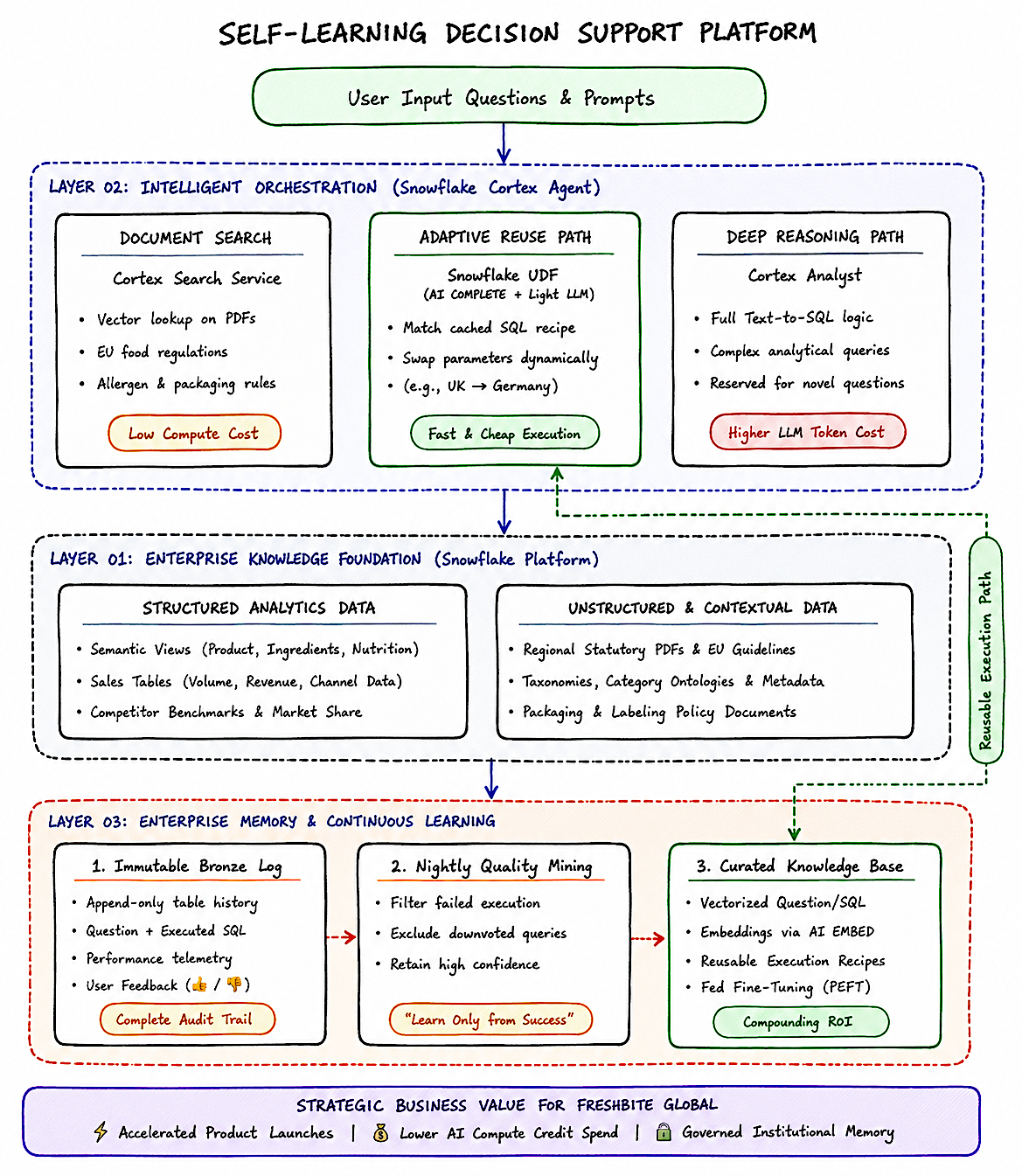
Layer 02: Intelligent Orchestration
Snowflake Cortex Agent evaluates user intent and routes the query through the most efficient execution path:
- Document Search Path: Uses Cortex Search for fast, low-cost vector retrieval over regulatory PDFs.
- Adaptive Execution Path (Pattern Reuse): Managed services like Cortex Analyst and Cortex Agent operate with fixed, heavyweight underlying models. To achieve true cost efficiency, the platform routes validated query patterns to a custom Snowflake User Defined Function (UDF). Inside this UDF, the platform uses AI_COMPLETE(), which uniquely grants the choice to select much lighter, smaller LLM models at runtime. The lighter model simply adapts parameters (such as changing country from UK to Germany or product from Oat Bites to Protein Crunch) on top of the previously verified SQL recipe, delivering near-instant execution against live data while bypassing the high compute cost of full text-to-SQL reasoning.
- Deep Reasoning Path: Reserves full text-to-SQL generation via Cortex Analyst exclusively for novel, complex analytical requests.
Layer 03: The Self-Learning Engine
This is where the platform turns daily usage into institutional memory:
- Immutable Bronze Logging: Every interaction (the natural language question, the physical SQL generated, execution telemetry, and explicit user feedback such as thumbs up or down) is logged in an append-only Bronze table in Snowflake.
- Nightly Quality Mining: Scheduled background processes evaluate these logs. Failed queries, unverified SQL, and downvoted responses are automatically purged to prevent polluting platform memory.
- Knowledge Base Curation: Approved Question-SQL pairs are converted into vector embeddings via AI_EMBED and stored in an enterprise Knowledge Base.
When a product manager in Germany asks a question that the UK or French team effectively solved the previous month, the system does not start from scratch. It recognizes the pattern, adapts the recipe via the lightweight UDF path, and executes it against live German market data.
The more the platform is used, the larger its repository of verified execution recipes becomes, making the entire system faster, more accurate, and significantly cheaper to run over time.
Future Roadmap: From Adaptive Reuse to Fine-Tuned Intelligence
Adapting SQL templates is an effective first step, but it is not the end state.
As the platform operates in production, the append-only Bronze log continuously accumulates verified interactions across regional business units. Every approved query, execution outcome, and feedback signal builds a rich dataset reflecting how FreshBite actually works, capturing its specific terminology, category definitions, and compliance rules.
This dataset forms the foundation for the next stage of development: native model fine-tuning within Snowflake.
Using Parameter Efficient Fine Tuning (PEFT), FreshBite can train smaller, open-weights models (such as Llama 3.1 8B or Mistral 7B) directly inside the Snowflake environment. Instead of relying on general-purpose LLMs to reason through queries from scratch, these specialized models internalize the company's schema patterns and regulatory language.
Integrated directly into the orchestration layer, these fine-tuned models handle incoming requests with higher precision, lower latency, and significantly smaller compute footprints. The platform shifts from simply remembering previous solutions to naturally understanding the language and decision logic of the enterprise.
Business Impact & Value Creation
By grounding self-learning decision support directly inside Snowflake, FreshBite achieves four clear outcomes:
- Accelerated Time-to-Market: Product launch evaluations drop from weeks of manual alignment across departments to near-real-time verified answers.
- Decreased AI Compute Costs: As adoption grows, more queries are handled by low-cost parameter adaptation using lighter models in UDFs rather than expensive LLM reasoning, lowering credit consumption per query.
- Maximized Technology ROI: Leverages existing Snowflake investments by unifying data tables, document vector search, and LLM orchestration within a single governed security boundary.
- Governed Institutional Memory: Preserves business logic across regions, eliminating repeated manual work and ensuring consistent regulatory compliance worldwide.
Closing Thoughts
Becoming a true self-learning enterprise is no longer about deploying larger or more complex AI models. For global organizations like FreshBite, true competitive advantage comes from building platforms that retain operational experience and continuously learn from daily usage.
By anchoring decision support natively within Snowflake as the Enterprise Data Platform, FreshBite bridges the gap between structured analytics and unstructured institutional knowledge. The platform does not re-solve the same business problems every day. Instead, it captures validated execution patterns, adapts them dynamically using optimized, lightweight models, and builds a compounding repository of corporate intelligence.
Caching the recipe rather than the meal turns every product launch evaluation into an enterprise asset. As usage expands across markets, decision-making becomes faster, cheaper, and more consistent, transforming Snowflake from a passive data repository into an active, self-learning driver of global product growth.