In many organizations, the challenge is no longer access to information — it is making sense of it.
If you ask a knowledge worker what slows them down, the answer is rarely that they lack data. More often, it is frustration: they know the answer exists somewhere, but finding it is time-consuming, inconsistent, and often unreliable.
Over time, enterprises have accumulated vast amounts of knowledge across collaboration tools, documentation platforms, code repositories, and communication channels. Slack threads capture real-time problem solving, documentation repositories hold formal processes, and emails contain critical decisions. But these systems were never designed to work together. The result is a fragmented knowledge landscape where information exists, but remains difficult to access when it matters most.
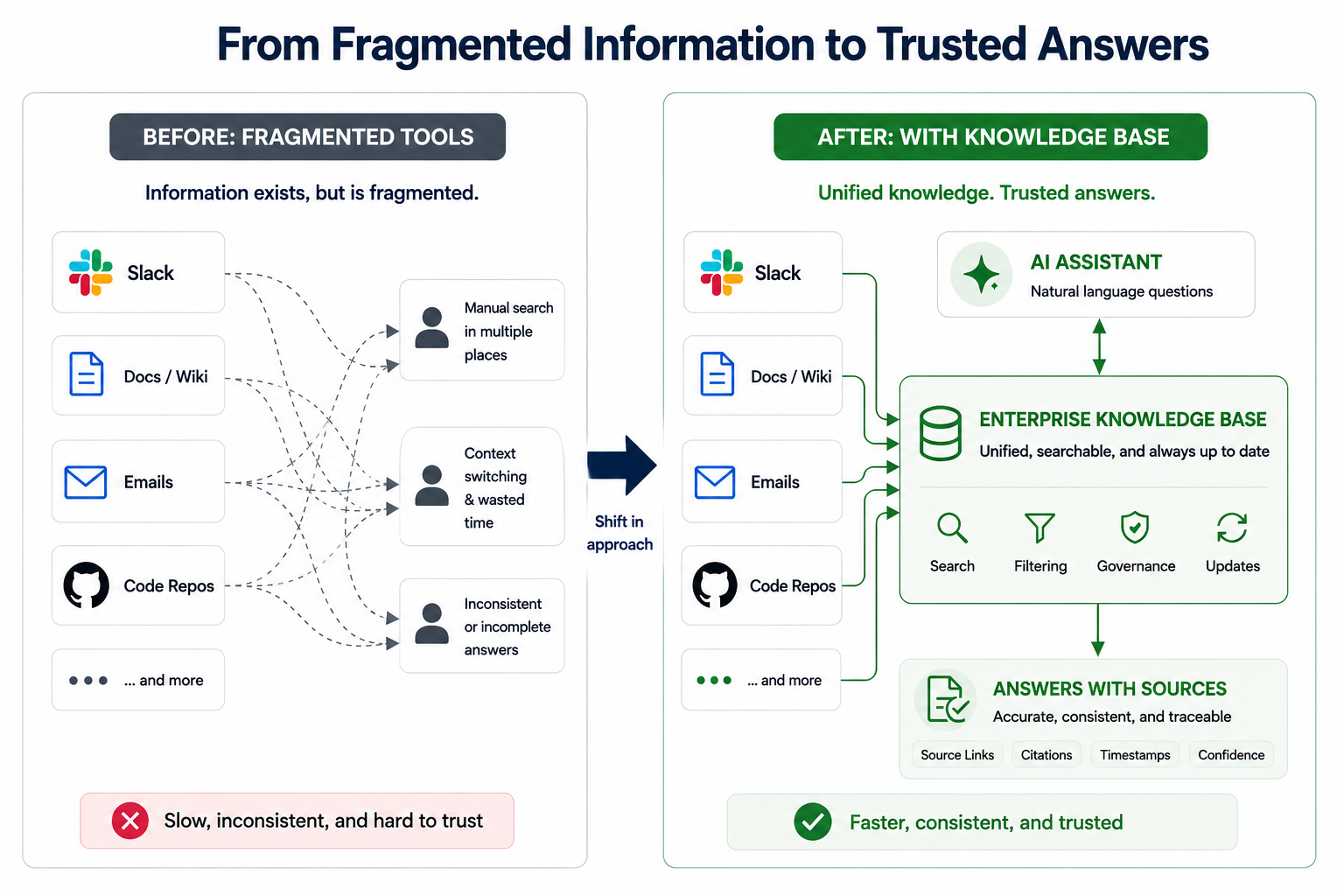
Figure 1: Before and after — fragmented tools versus a unified Enterprise Knowledge Base delivering trusted answers with sources.
This fragmentation shows up in subtle but costly ways.
New hires spend weeks or months ramping up, relying on colleagues for context that already exists. Support teams sometimes provide incomplete answers because the most relevant resolution is buried in an old conversation. Teams unknowingly duplicate work that has already been done elsewhere. And when experienced employees leave, much of their knowledge leaves with them.
Individually, these are small inefficiencies. At scale, they become a meaningful drag on productivity, decision-making, and organizational learning.
Listening to Customers: A Pattern Emerges
As we worked with customers across industries — from financial services to enterprise technology — these challenges appeared consistently, regardless of the company's size or maturity.
What stood out was not the lack of knowledge, but how difficult it was to use effectively.
One common refrain was surprisingly simple: "We already have the knowledge. We just can't find it." Organizations had invested years in building documentation, resolving issues, and capturing institutional experience. Yet employees still spent significant time searching, often abandoning the effort when answers weren't easily accessible.
Another pattern became clear when we looked at how people actually search for information. Traditional enterprise search works well when users know exactly what they're looking for and how to phrase it. But that's rarely the case. Employees don't think in keywords — they think in questions. They want to understand why something happened, whether it has happened before, and what the best course of action is.
This gap between how systems expect queries and how people naturally ask questions creates friction.
Traditional search returns documents. Modern Knowledge Bases deliver answers.
Perhaps the most important insight, however, was about trust. Customers repeatedly emphasized that any system providing answers needed to be transparent. It wasn't enough for an answer to sound correct — users needed to know where it came from, whether it was current, and whether it could be verified. Without that, even the most sophisticated solution would struggle to gain adoption.
A Shift in Thinking: From Search to a Knowledge Base
These patterns led to a shift in how we approached the problem.
The goal was not to build a better search tool. It was to rethink how organizations access and use knowledge altogether.
At IBM, these customer engagements shaped how we approached enterprise AI. Rather than building another search interface, we focused on helping organizations create a trusted Enterprise Knowledge Base using Watsonx Orchestrate, watsonx.ai, and watsonx.data.
This is where the concept of an enterprise Knowledge Base becomes important. Rather than treating knowledge as something scattered across systems, a Knowledge Base creates a unified layer that connects existing information and makes it accessible in a way that aligns with how people actually work.
In practice, this means employees can ask questions in natural language and receive clear, contextual answers grounded in the organization's own knowledge — with sources attached.
The goal isn't for AI to know everything — it's for AI to reliably find and use the right organizational knowledge at the right time.
What Customer Use Cases Taught Us
Building this capability across real environments surfaced a set of lessons that were consistent, regardless of industry or use case.
Most organizations already had the knowledge they needed. The real challenge was unlocking it. Valuable insights were buried in conversations, documents, and historical records that were technically accessible but practically out of reach. When these sources were connected and made searchable in a meaningful way, organizations quickly began seeing benefits — including faster access to information, less duplicated work, and better reuse of existing knowledge.
User expectations have fundamentally changed. Employees increasingly expect the same level of simplicity and responsiveness from internal systems that they experience in consumer tools. They don't want to search through documents — they want direct answers to their questions. When organizations enable this shift from "searching" to "asking," adoption tends to accelerate quickly.
Trust remains the defining factor. In environments where answers influence decisions — whether in engineering, operations, or customer support — transparency is critical. Showing where information comes from and allowing users to verify it builds confidence and drives sustained usage.
Technology alone doesn't solve knowledge management. Organizations that invested time in organizing and maintaining their knowledge consistently achieved better business outcomes than those that focused solely on adopting newer AI tools.
The most successful implementations treated the Knowledge Base as an evolving capability, not a one-time initiative. As organizations added new content, refined how information was structured, and learned from how employees asked questions, the system became more valuable over time. The result was not just incremental improvement, but compounding value.
What This Looks Like in Practice
The impact of this shift becomes clear in everyday scenarios.
Onboarding becomes faster and more consistent when new employees can access reliable information without relying solely on tribal knowledge. Support teams resolve issues more quickly when they can surface relevant past solutions instantly. Cross-team collaboration improves when knowledge is no longer locked in silos but shared across the organization. And perhaps most importantly, institutional knowledge becomes durable — no longer tied to individual employees, but preserved and accessible over time.
This is more than an efficiency gain. It represents a shift from fragmented information to accessible, actionable organizational intelligence.
Why This Matters Now
The urgency of this problem has grown in recent years.
The emergence of generative AI has raised expectations, but it has also exposed the limitations of fragmented enterprise knowledge. AI can only provide trustworthy answers when it has access to trustworthy organizational knowledge.
Organizations are using more tools than ever before, creating more content at an accelerating pace. At the same time, expectations around AI-driven experiences are rising. Employees now expect to interact with systems in natural language and receive immediate, relevant responses.
Without a unified approach to managing and accessing knowledge, these trends only amplify fragmentation.
Organizations that address this challenge early gain a meaningful advantage. They make better decisions, respond more quickly to challenges, and get more value from the knowledge they already possess.
Looking Ahead
In this first part, we focused on the business problem and the patterns observed across customer use cases. The takeaway is clear: the challenge is not creating more knowledge, but making existing knowledge usable.
In Part 2, we shift from why to how — exploring how to build an enterprise Knowledge Base using IBM watsonx, including how to connect data sources, structure knowledge, and enable intelligent, trustworthy responses through an AI assistant.