Quantum is futuristic?
Even though there is no such thing as a time machine (yet?), attending the IBM Quantum Workshop in Amsterdam felt like taking a peek at a future of computing that is approaching us at ever-increasing speed. The event drew a diverse crowd, varied in as many ways as a qubit can spin. This led to fascinating discussions not just about the technology behind quantum computers, but also about its implications for our digital security. During the workshop we were guided by some bright minds who helped us get to grips with the jargon needed to understand quantum computing, with the cherry on top being the chance to put theory into practice on actual quantum hardware provided by IBM.
The Qubit: The Building Block of Quantum Computing
At the center of quantum computing lies the qubit. Where a classical bit exists in either a state of on or off (1 or 0), a qubit can exist in both states simultaneously until the moment it gets measured and its state collapses into either a 1 or a 0. Think of it like tossing a coin: while it's in the air, it is neither heads nor tails yet. That in-between state is what we call **superposition**.
Entanglement and Gates: Where It Gets Interesting
If superposition already sounds cool, things get even more interesting when you add a second qubit. Through **entanglement**, the value of one qubit can influence another. Using our coin analogy: if coin 1 lands on heads, coin 2 will always land on tails, no matter what.
This influencing of qubits is done through **gates**, which work much like the logical gates inside a CPU that control how bits are processed. Through gates, a developer on a quantum computer controls how and on which qubits operations occur. The two most fundamental gates are:
Hadamard gate — puts a qubit into a state of superposition
CNOT gate — links a source qubit to a target qubit and flips the target's value based on the source (if qubit 1 is 1, qubit 2 becomes 0)
Once the computation is done, a **measurement** collapses the qubit states into classical results you can actually read.
The "Hello World" of Quantum Computing
The simplest example of all this in action is the **Bell state** which essentially is the "Hello World" of quantum computing. It brings two qubits into an entangled state and measures the results, which in an ideal scenario produces a 50/50 distribution of 00s and 11s. Simple, yet a perfect illustration of what makes quantum computing so fundamentally different.
The best part is that you do not need a PHD and a bag of money to try writing this “Hello World”-example yourself. All you need is:
1. A computer (quantum is optional)
2. Python
3. Editor
4. (Optional) Bob, for when you want the code <i>yesterday</i>
Install Qiskit with a single command `pip install qiskit` and you're ready to go. The code looks like this:
```python
from qiskit.primitives import StatevectorSampler as Sampler
from qiskit import QuantumCircuit
# Create a circuit with 2 qubits and 2 classical bits
qc = QuantumCircuit(2, 2)
# Put qubit 0 into superposition (Hadamard gate)
qc.h(0)
# Entangle qubit 0 with qubit 1 (CNOT gate)
qc.cx(0, 1)
# Measure both qubits
qc.measure([0, 1], [0, 1])
print(qc.draw())
# Run locally using the built-in Sampler primitive
sampler = Sampler()
job = sampler.run([qc], shots=1024)
result = job.result()
counts = result[0].data.c.get_counts()
print(counts)
```
This would produce the following Quantum Circuit:
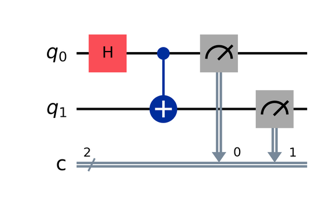
Run the circuit 1024 times and you get something like `{'11': 503, '00': 521}` — nearly a perfect 50/50 split. That's entanglement doing its thing. Not bad for ten lines of code!
Wrapping Up
The IBM Quantum Workshop was a great success — not in the least thanks to educators who had a real knack for making these concepts land, and to the attendees who brought enthusiasm, experience, and plenty of great conversation to the table.
And when this thing really takes off a few years from now, we can all brag about having coded on a quantum computer before it was cool. And that is definitely something worth bragging about!