1. Why Multi-Arch Matters in the AI Era
Walk into almost any enterprise data center today and you will find a heterogeneous estate: x86_64 servers running virtualized general-purpose workloads, ARM64 creeping in at the edge and in the public cloud, and IBM Power running the systems the business cannot afford to lose — core banking, ERP, healthcare records, manufacturing execution. The question is no longer “which architecture wins?” but “how do we operate all of them as one platform?”
That question got a lot more interesting in July 2025, when IBM launched Power11. For the first time in the platform’s history, high-end (E1180), mid-range (E1150), and scale-out (S1124, S1122) servers all shipped on general availability day — and, in another first, Power11 was available in the cloud from day one via IBM Power Virtual Server. Power11 is not positioned as an incremental refresh: it is a redesign across processor, hardware architecture, and the virtualization stack, built for a world where hybrid cloud is the default and AI inference runs next to the data.

Power11 at a glance
This post looks at Power11 through a multi-architecture lens: how to design a hybrid estate around it, how to run DevOps pipelines that treat ppc64le as a first-class citizen alongside x86_64 and ARM64, and how to decide which workloads belong where.
2. The Hybrid Estate: Deployment Models with Power11
Power11 gives you three deployment building blocks, and most real estates will combine at least two of them:
• On-premises enterprise: the Power E1180 for the largest consolidated environments (up to 256 cores and very large memory footprints), and the E1150 for mid-range consolidation. These are the natural home for AIX and IBM i estates with strict latency, sovereignty, or compliance demands.
• On-premises scale-out: the S1124 and the compact 2U S1122 bring Power11 economics to smaller footprints and edge locations — useful when you want inference or data processing close to where data is generated.
• IBM Power Virtual Server (PowerVS): Power11 capacity in IBM Cloud, consumable on demand. Because it is the same architecture, AIX, IBM i, and Linux on Power images move between on-prem and cloud without recompilation.
Hybrid patterns that work
• Dev/test in PowerVS, production on-prem. Spin up short-lived AIX or IBM i LPARs in the cloud for testing OS levels and application changes, without touching production frames.
• DR in the cloud. Replicate to PowerVS instead of maintaining a second physical site. Capacity is paid for meaningfully only when you fail over or test.
• Burst and migrate. Seasonal or project-driven capacity in PowerVS, with steady-state workloads on owned Power11 frames where the TCO is best.
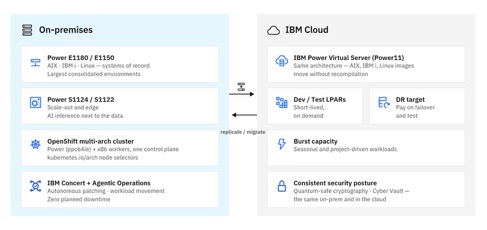
Figure 1: One architecture, two locations — the Power11 hybrid estate
3. The Full-Stack Operations Story
Power11’s operations story is where IBM is leaning on its whole portfolio rather than the Power stack alone. Three pieces matter for hybrid operators:
• Zero planned downtime. Power11 is designed for 99.9999% availability, with planned maintenance downtime driven to zero through autonomous patching and automated workload movement — firmware and stack updates apply while workloads keep running or are moved live.
• IBM Concert. An AI-powered operations center from the watsonx family that watches the estate, correlates risk (including CVE exposure), and drives remediation — across on-prem frames and PowerVS.
• Agentic Operations for IBM Power. IBM’s newer autonomous software offering pushes further in the same direction: agents that plan and execute routine operational tasks instead of just alerting a human.
For a multi-arch shop, the practical takeaway is that the Power side of the estate can now match — and often exceed — the automation posture teams have built on x86 with tools like Ansible. And since Ansible itself fully supports AIX, IBM i, and Linux on Power, one automation codebase can span the whole estate.
4. Multi-Arch DevOps in Practice
This is where multi-architecture stops being a slide and becomes a build pipeline. The goal: one Git repository, one pipeline, artifacts for ppc64le, x86_64, and ARM64.
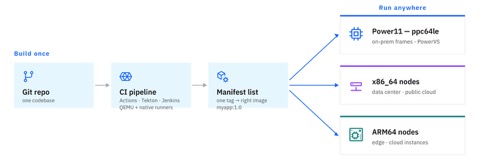
Figure 2: Build once, run on ppc64le, x86_64, and ARM64 via a single manifest list
Building multi-arch container images
Podman and Buildah handle multi-arch builds through manifest lists — a single image tag that resolves to the right architecture at pull time:
# Create a manifest and build for three architectures
podman manifest create myapp:1.0
podman build --platform linux/amd64,linux/arm64,linux/ppc64le \
--manifest myapp:1.0 .
# Push the manifest list to your registry
podman manifest push myapp:1.0 quay.io/myorg/myapp:1.0
A node pulling quay.io/myorg/myapp:1.0 gets the ppc64le layer on Power and the amd64 layer on x86 — no tag gymnastics, no per-arch deployment manifests.
CI/CD pipelines that target multiple architectures
In GitHub Actions, a build matrix plus QEMU emulation covers architectures you don’t have native runners for:
jobs:
build:
runs-on: ubuntu-latest
steps:
- uses: actions/checkout@v4
- uses: docker/setup-qemu-action@v3
- uses: docker/setup-buildx-action@v3
- uses: docker/build-push-action@v6
with:
platforms: linux/amd64,linux/arm64,linux/ppc64le
push: true
tags: quay.io/myorg/myapp:${{ github.sha }}
Emulated builds are convenient but slow for compile-heavy projects. For serious throughput, add a native ppc64le runner — a small LPAR on-prem or a PowerVS instance registered as a self-hosted runner — and keep emulation for quick validation. Tekton on OpenShift takes this further: pipeline tasks are scheduled onto worker nodes of the target architecture, so every build is native.
OpenShift multi-arch compute
Red Hat OpenShift supports clusters that mix Power and x86 worker nodes under a single control plane. Placement is standard Kubernetes scheduling:
spec:
nodeSelector:
kubernetes.io/arch: ppc64le # pin to Power workers
This is the pattern that makes “run the app next to the data” real: the cloud-native front end can run on x86 workers while the data-intensive service that talks to Db2 or Oracle on AIX runs on Power workers — in the same cluster, same GitOps flow, same observability stack.
Gotchas to plan for
• Base images: confirm your base images publish ppc64le variants (UBI, Alpine, and most official language images do; some community images do not).
• Native dependencies: anything with C extensions (Python wheels, Node native modules) needs a ppc64le build path — check for prebuilt wheels or budget compile time.
• Emulation vs. cross-compilation: QEMU emulation is simple but can be 5–10x slower for compilation; Go-style cross-compilation or native runners avoid the tax.
• Test on target: unit tests under emulation are fine; run integration and performance tests on real Power hardware or PowerVS.
5. Linux and Open Source on Power11
The open-source story on ppc64le is far more mature than teams new to Power often expect. RHEL, SLES, and Ubuntu all ship for Power. PostgreSQL, MariaDB, MongoDB, Redis, Kafka, and the core Kubernetes/OpenShift ecosystem run as first-class citizens, with packages available through standard distribution channels or official container images. Power11’s high thread density — scaling to thousands of threads in the largest configurations — suits exactly these throughput-oriented, concurrent workloads.
Where you still need attention: newer or niche projects whose CI does not include ppc64le, prebuilt binaries distributed only for amd64/arm64, and some observability agents. The usual fix is building from source in your own pipeline — which the Section 4 setup already gives you. A good habit: make “ppc64le supported?” a checkbox in your technology-selection process rather than a discovery during rollout.
6. Workload Placement Strategy
With the estate and pipelines in place, the architectural question becomes placement. A practical decision framework:
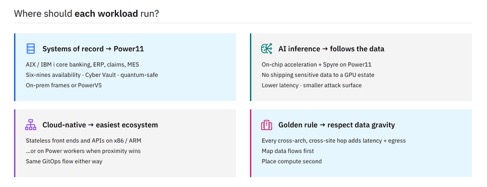
Figure 3: A practical workload placement framework
• Systems of record stay on Power. AIX and IBM i workloads — core banking, ERP, claims, manufacturing — get Power11’s availability and security posture, on-prem or in PowerVS.
• AI inference follows the data. Power11 includes on-chip acceleration for inference, extensible with the IBM Spyre Accelerator. Running inference on the same platform as the data avoids shipping sensitive records to a separate GPU estate — lower latency, smaller attack surface, simpler compliance.
• Cloud-native services go where the ecosystem is easiest. Stateless front ends and APIs can run on x86 or ARM in public cloud — or on Power workers in a multi-arch OpenShift cluster when proximity to data matters more than ecosystem convenience.
• Respect data gravity. Every hop between architectures and locations adds latency and egress cost. Map data flows first; place compute second.
7. Security and Resilience Across the Hybrid Boundary
A hybrid estate is only as strong as its most weakly governed segment, so consistency is the goal:
• Quantum-safe by default. Power11 ships with quantum-safe cryptography aimed at harvest-now, decrypt-later attacks — relevant today for data with long confidentiality lifetimes.
• Ransomware defense in hardware and firmware. IBM Cyber Vault provides immutable snapshots and is designed to detect ransomware activity in under a minute, giving you a clean restore point and an early alarm.
• Memory-level hardening. Hardware memory tagging validates buffer accesses at the cache-line level, blunting classes of buffer-overflow and side-channel exploitation.
• One DR story. Replication into PowerVS gives Power workloads a cloud DR target on the same architecture, while your x86 estate uses its own cloud DR — orchestrated under one runbook and one test calendar.
8. Conclusion and Getting Started
Power11 changes the multi-arch conversation. It arrived as a full family — entry to enterprise, on-prem and cloud, on day one — with an operations model (autonomous patching, Concert, agentic operations) that lets Power match the automation culture of the rest of the estate, and a DevOps story (manifest lists, multi-arch OpenShift, native runners) that makes ppc64le just another target in the pipeline rather than a special case.
If you want to start small:
• Add linux/ppc64le to one container build and see what breaks — usually less than you expect.
• Stand up a PowerVS instance as a dev/test or CI target; no hardware required.
• Pilot a multi-arch OpenShift cluster with a single Power worker node.
• Join the conversation in the IBM Power Global community — share what worked and what didn’t.
The architectures in your data center aren’t going to converge. Your operating model can.